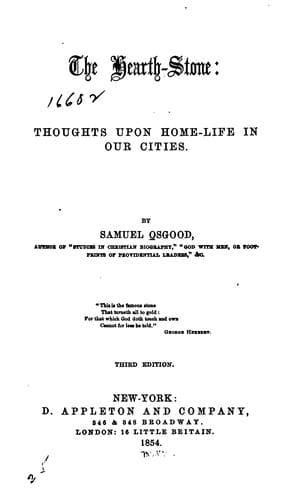
The Hearth-Stone: Thoughts Upon Home-Life in Our CitiesOsgood, Samuel
Religion
The Hearth-Stone: Thoughts Upon Home-Life in Our Cities
Osgood, Samuel
Christian life; Conduct of life
griefs have their succession, and a thread of tragedy runs through their
whole history. Every family is troubled with its besetting sorrows and
sins. No man is wise until he understands his own pedigree, and interprets
himself, not simply as an isolated fact in the world, but as a branch of
the life-tree upon which he grew. If reflection does not inform the
family of its peculiar traits, experience will not fail to make the
revelation. The idle chat of the house will often exhibit the ruling
spirit, and the prattle of many a lisping child betrays the idols that he
has been trained to honor. Some names of folly or wisdom most frequent on
the lips alike of parents and children, will be the household words that
show the spirit that predominates. These names, and all attendant
influences, are to be judged by their bearing on the true aims of home.
Ask a few plain questions as the Master asks in the appeals of his
religion.
Does content live with us, or its opposite, discontent? The question
cannot be answered by any general considerations of fortune or position.
Surely discontent is found in the most extreme cases, and wealth feels
often very poor and limited because its desires rise with its means, and
its means may be distanced far by some more successful aspirant to
fortune. Discontent, ready guest of heart and home always, but never more
frequent than among us with whom plenty so swells desire, and competition
so quickens rivalry! With us, alas, too frequent guest, impoverishing
abundance by inordinate desires, and burdening too many with cares and
anxieties beyond reason and beyond strength! Often sad effect of our
luxurious civilization, that in apparently the greater number of
households, property brings new forms of want, and the demands of
ostentation become more rapacious than the natural appetites! How many
need now and always to lower their vain pride, and dignify their
mediocrity or consecrate their affluence by hearing the Master's voice
"Come down: to-day I must abide in thy house."
In some especial form the spirit of discontent is apt to tempt every
household, in view of some especial want, or vanity, or ambition. With it,
too, come some elements of strife, or indifference, or worldliness, that
need peculiar watching. Domestic life, indeed, is sacred from prying
curiosity, and it argues generally little to one's credit, to be very
accurately posted up in the accounts of home troubles. Without playing the
part of the busybody, we may study the facts of human nature, and be aware
of the developments of society. We may believe, that where several wills
are brought together, they can harmonize only as they agree by appealing
to a common standard; that no tempers, however pliant, can accord without
mutual principle; that none in authority can govern others without first
governing themselves; that a Christian spirit, earnest, kindly, devoted,
is the only safeguard of the peace and elevation of the home.
Public-domain text, read in full here on John Shaqi.
Reviews
Reviews
No reviews yet
Be the first to share your thoughts on this work.
Elsewhere in the archive
Join the Discussion
Join the discussion
Sign in to leave a comment or review.
Sign InorCreate an account