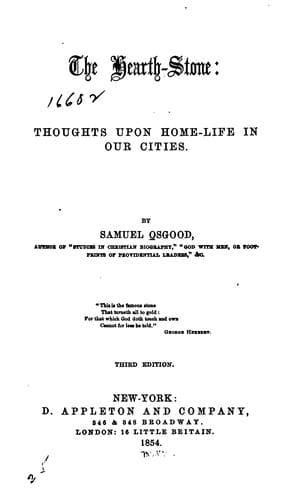
The Hearth-Stone: Thoughts Upon Home-Life in Our CitiesOsgood, Samuel
Religion
The Hearth-Stone: Thoughts Upon Home-Life in Our Cities
Osgood, Samuel
Christian life; Conduct of life
The genial air of May comes to us all laden with the sweet breath of
opening blossoms, and has a balm for the spirits as well as for the
health. It stirs within us a sentiment deeper than we know how to define,
revives our chilled or buried ideals, and makes every heart young again.
It cannot but give something of its own tone to our thought, and we find
that in all nations this month has been a continued festival in the
calendar, and associated with the loveliest imagery of earth and heaven.
The heathen nations, who gave the month its present name, called it so
after the fairest of their goddesses, and Christians following a similar
sentiment, and desirous also of enlisting every natural feeling in the
service of a purer faith, transferred the honors of Maia to Mary, and in
every land white flowers deck the shrines of the Madonna, and the "Hail
Mary" is the burden of the matin and vesper hymn. Some of the hymns and
aspirations connected with the season convey thoughts with which an
earnest Protestant may sympathize, and grateful for the maternal love that
has made our lives so blessed, we cannot ridicule, although we cannot
imitate the Italian devotee, who salutes the Holy Mother as the
representative of God's tender mercy to man through her sex, in words of
such fervor:--
"Joy of my heart! O let me pay
To thee thine own sweet month of May.
Mother! be love of thee a ray
From Heaven to show the heavenward way.
Sweet Day-Star! let thy beauty be
A light to draw my soul to thee."
May we not once more speak the name of Mary, the Blessed Mother, not to
adore her as a divinity, but to win from her an illustration of our common
humanity in one of its great sorrows and consolations? Cheerfully as under
the returning smile of heaven, solemnly as in presence of much grief, our
meditation now turns upon orphanage of the affections, as one of the facts
of our homes, and upon the secondary relations which may be its solace.
* * * * *
Public-domain text, read in full here on John Shaqi.
Reviews
Reviews
No reviews yet
Be the first to share your thoughts on this work.
Elsewhere in the archive
Join the Discussion
Join the discussion
Sign in to leave a comment or review.
Sign InorCreate an account