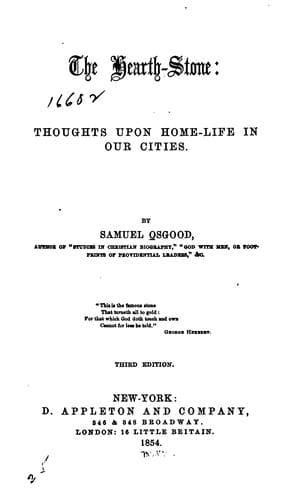
The Hearth-Stone: Thoughts Upon Home-Life in Our CitiesOsgood, Samuel
Religion
The Hearth-Stone: Thoughts Upon Home-Life in Our Cities
Osgood, Samuel
Christian life; Conduct of life
Consider, first of all, the fact as one of the events of every life,
sooner or later. Mary at the Cross is a representation of our common
humanity in its bereavements. Every mother and every parent in some way
enters into her anguish, as she saw the life of her Divine Son ebbing from
those cruel wounds. She was indeed doubly bereaved,--at once childless and
fatherless for the victim upon the Cross had been at once the son of her
travail and the father of her faith, born of her into the world that she
might be born of Him into the spiritual kingdom. His own pains did not
make Him insensible to her anguish, nor indifferent to the fact common to
our nature, which feels itself always so void and desolate, when the being
of all most loved is suddenly taken away. Tenderly He provided for her the
consolation that she needed, by commending her to the disciple, whose ever
present kindness would be so great a solace in itself, and so powerful a
remembrance of the departed by its associations. The disciple took to his
house from that hour the mother of Him upon whose bosom he had leaned.
Life is full of cases that illustrate the same principles, although not
connected with facts so peculiar. It may be said indeed, that some kind of
orphanage is the lot of every person, whose years are not early cut off,
and whose heart is not utterly hardened against home affections. The order
of nature is that children should survive their parents, and very many of
us in tender childhood have learned the worth of kind and judicious
parents, by being called to face the trials and cares of life without
their counsel and comfort. When the case is reversed, and the parent is
mourner for the child, the desolation of the heart is quite as great, and
the affections, deprived of their wonted object, are, perhaps, more deeply
wounded than the child's can be, even when losing the only protector in
losing the parent; so strongly do the affections press downward, and so
mightily does the love that sacrifices so much for offspring grow by its
own exercise. Every day this bereavement strikes somewhere, and since my
last word to you, it has stricken parents whose oldest child was last
Sunday present at church, and to-day is in his grave;--on Sunday I spoke
to that bright boy pleasantly at our school, and on Friday said the
funeral service over his coffin. Never can such a bereavement come without
leaving a feeling of double orphanage, for parents in losing their
offspring lose at once an instructor as well as a pupil; and surely the
eldest born of a family, however young, is spiritually father or mother of
much that is best in the parent's heart. Survey life in its whole compass,
enlarge our own experience by observation, and we need no argument to
interpret Mary's desolation at the Cross, or to learn that some form of
orphanage is the common lot; nay, that before life ceases, some portion of
our life is severed, when those in whose companionship we had lived are
taken away.
Public-domain text, read in full here on John Shaqi.
Reviews
Reviews
No reviews yet
Be the first to share your thoughts on this work.
Elsewhere in the archive
Join the Discussion
Join the discussion
Sign in to leave a comment or review.
Sign InorCreate an account