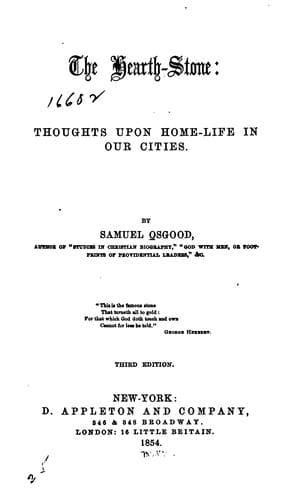
The Hearth-Stone: Thoughts Upon Home-Life in Our CitiesOsgood, Samuel
Religion
The Hearth-Stone: Thoughts Upon Home-Life in Our Cities
Osgood, Samuel
Christian life; Conduct of life
The great security, that this shall be so, is found where Christ placed
it, in the Father. "I will not leave you comfortless,"--or orphaned, as
the word is literally to be translated,--"I will come to you. Ye shall
know that I am in my Father, and ye in me, and I in you." They that learn
to live in the Father's love, are saved from the worst bereavement, and
the orphanage of the earth opens to them the parentage of heaven. The
first and secondary relationships of earth are both commended and
consecrated by the relation prior to them both and primal of all, however
late it may be understood; for in spiritual as well as earthly ties, it
requires time and thought to know our truest friend; and the playmates of
an hour win the child of mortality's ear more readily than the far-seeing
parent, or than the Ancient of Days, the Father of all. Remember that
whatever paternal wisdom or maternal tenderness we have ever known here,
has its source and archetype on high. There dwells the Godhead that spoke
and wrought through the victim of the Cross; there shines the wisdom that
opened that disciple's vision; there burns the love that glowed in the
mother's faithful heart. From the unseen, comes all the glory that is
seen; and if any of us have an orphaned heart, as in some respects we all
may have, let us find its solace in God, and whatever is God's. Let the
sweet breath of May, that whispers to devotees of Mary's holy maternity,
fill our hearts with more than vernal promise, ideals of more than human
loveliness,--call us away from all wintry chills to the light and love of
the Parent above all parents--to the home that unites all homes in one.
_May._
The Young Prodigal.
THE YOUNG PRODIGAL.
How marked and how various has been the response of men to the Parable of
the Prodigal Son since it first came from the lips of Him whose life so
exemplified its mercy. Through all those changing centuries, the home has
kept its place in the affections of mankind, and that pathetic domestic
picture has never failed to waken regrets and compassion. The happiest
household is not without some errors that cry for forgiveness, and not
many are the families whose peace is not troubled by some prodigal. The
parable presents at once an example of earthly experience and a lesson of
heavenly mercy. Not forgetting the heavenly lesson, we dwell now more upon
the earthly example, as we speak of the prodigal in the family, especially
of his fall and his recovery.
* * * * *
Public-domain text, read in full here on John Shaqi.
Reviews
Reviews
No reviews yet
Be the first to share your thoughts on this work.
Elsewhere in the archive
Join the Discussion
Join the discussion
Sign in to leave a comment or review.
Sign InorCreate an account