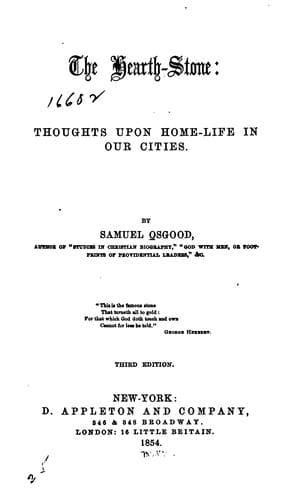
The Hearth-Stone: Thoughts Upon Home-Life in Our CitiesOsgood, Samuel
Religion
The Hearth-Stone: Thoughts Upon Home-Life in Our Cities
Osgood, Samuel
Christian life; Conduct of life
The prodigal in the family! Far more frequently than the world knows,
might this epithet in truth be spoken, for it is not by any means from
notorious spendthrifts and open profligates, that wicked waste scatters
the goods of a household. If a certain man who had two sons, found in one
of them a prodigal under the simple manners of a rustic age, what may the
father of a large family anticipate in a state of society which makes
extravagance almost a necessity, and in a great city which brings the
vices and follies of every far country on earth to his very door. Never
perhaps since Jesus spoke, have His words found more ample illustration
than in this great city, that calls thousands and tens of thousands of
young men from rural homes to the fierce scramble for gold, and the
feverish chase for pleasure, and which in so many ways offers to drown in
dissipation the anguish of remorse.
It is not by any means always the worst boy of the family who takes the
road to ruin. It may be base passion or reckless selfishness that leads
him astray, but it is quite as likely to be too cordial impulses, exposing
him to enticing companions, or too sanguine hopes, entailing upon him
disappointment and despair. Of the many prodigals whom we have known in
our own lifetime, not a few surely have been generous natures, whom it was
impossible not to pity, and not hard to love. Sometimes the very
temperament that makes a youth amiable, and that should make him noble,
wins to him the most alluring of tempters, and he falls before some Satan
who comes to him as an angel of light.
The very tenderness shown to him at home may add to his besetting
weakness, by encouraging habits of self-indulgence. In fact, the parable
itself allows room for the surmise, that the younger son, from having
less care put upon him than the elder, was less schooled in self-reliance,
and because every thing was done for him as the pet of the family, he was
in danger of doing too little for himself. Certainly indulgence may be as
dangerous an extreme as sternness, and as many youths are spoiled by over
fondness as are made desperate by unkindness. Sometimes both extremes
unite in the same fitful temper, and children, now petted and now cursed,
learn indolence and rebellion in the same perverse domestic school. Rare
is the wisdom that can adjust the discipline to each temperament, and
encourage without over-indulgence, and correct without harshness. Not
always, however, is the fault of the child to be traced to error in the
parent, for every child has powers and responsibilities of his own, and
besides his own perverse will, there is a third party that frequently
comes in to make mischief.
Public-domain text, read in full here on John Shaqi.
Reviews
Reviews
No reviews yet
Be the first to share your thoughts on this work.
Elsewhere in the archive
Join the Discussion
Join the discussion
Sign in to leave a comment or review.
Sign InorCreate an account