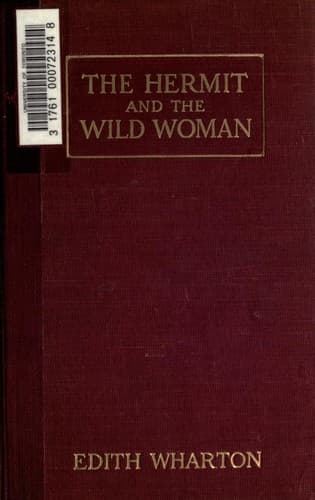
The Hermit and the Wild Woman, and Other StoriesWharton, Edith
General
The Hermit and the Wild Woman, and Other Stories
Wharton, Edith
Short stories, American
The Park was clothed in the double glitter of snow and sunshine. They
roamed the hard white alleys to a continuous tinkle of sleigh-bells,
and Kate brightened with the exhilaration of the scene. It was not
often that she permitted herself such an escape from routine, and in
this new environment, which seemed to detach her from her daily
setting, Stanwell had his first complete vision of her. To the girl
also their unwonted isolation seemed to create a sense of fuller
communion, for she began presently, as they reached the leafless
solitude of the Ramble, to speak with sudden freedom of her brother. It
appeared that the orders against which Caspar had so heroically steeled
himself were slow in coming: he had received no commission since the
sale of his group, and he was beginning to suffer from a reaction of
discouragement. Oh, it was not the craving for popularity--Stanwell
knew how far above that he stood. But it had been exquisite, yes,
exquisite to him to find himself believed in, understood. He had
fancied that the purchase of the group was the dawn of a tardy
recognition--and now the darkness of indifference had set in again, no
one spoke of him, no one wrote of him, no one cared.
"If he were in good health it would not matter--he would throw off such
weakness, he would live only for the joy of his work; but he is losing
ground, his strength is failing, and he is so afraid there will not be
time enough left--time enough for full recognition," she explained.
The quiver in her voice silenced Stanwell: he was afraid of echoing it
with his own. At length he said: "Oh, more orders will come. Success is
a gradual growth."
"Yes, _real_ success," she said, with a solemn note in which he
caught--and forgave--a reflection on his own facile triumphs.
"But when the orders do come," she continued, "will he have strength to
carry them out? Last winter the doctor thought he only needed work to
set him up; now he talks of rest instead! He says we ought to go to a
warm climate--but how can Caspar leave the group?"
"Oh, hang the group--let him chuck the order!" cried Stanwell.
She looked at him tragically. "The money is spent," she said.
He coloured to the roots of his hair. "But ill-health--ill-health
excuses everything. If he goes away now he will come back good for
twice the amount of work in the spring. A sculptor is not expected to
deliver a statue on a given day, like a package of groceries! You must
do as the doctor says--you must make him chuck everything and go."
They had reached a windless nook above the lake, and, pausing in the
stress of their talk, she let herself sink on a bench beside the path.
The movement encouraged him, and he seated himself at her side.
"You must take him away at once," he repeated urgently. "He must be
made comfortable--you must both be free from worry. And I want you to
let me manage it for you--"
He broke off, silenced by her rising blush, her protesting murmur.
Public-domain text, read in full here on John Shaqi.
Reviews
Reviews
No reviews yet
Be the first to share your thoughts on this work.
Elsewhere in the archive
Join the Discussion
Join the discussion
Sign in to leave a comment or review.
Sign InorCreate an account