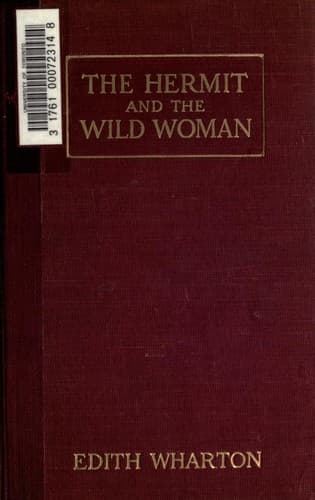
The Hermit and the Wild Woman, and Other StoriesWharton, Edith
General
The Hermit and the Wild Woman, and Other Stories
Wharton, Edith
Short stories, American
"Oh, stop, please; let me explain. I'm not talking of lending you
money; I'm talking of giving you--myself. The offer may be just as
unacceptable, but it's of a kind to which it's customary to accord it a
hearing. I should have made it a year ago--the first day I saw you, I
believe!--but that, then, it wasn't in my power to make things easier
for you. But now, you know, I've had a little luck. Since I painted
Mrs. Millington things have changed. I believe I can get as many orders
as I choose--there are two or three people waiting now. What's the use
of it all, if it doesn't bring me a little happiness? And the only
happiness I know is the kind that you can give me."
He paused, suddenly losing the courage to look at her, so that her
pained murmur was framed for him in a glittering vision of the frozen
lake. He turned with a start and met the refusal in her eyes.
"No--really no?" he repeated.
She shook her head silently.
"I could have helped you--I could have helped you!" he sighed.
She flushed distressfully, but kept her eyes on his.
"It's just that--don't you see?" she reproached him.
"Just that--the fact that I could be of use to you?"
"The fact that, as you say, things have changed since you painted Mrs.
Millington. I haven't seen the later portraits, but they tell me--"
"Oh, they're just as bad!" Stanwell jeered.
"You've sold your talent, and you know it: that's the dreadful part.
You did it deliberately," she cried with passion.
"Oh, deliberately," he interjected.
"And you're not ashamed--you talk of going on."
"I'm not ashamed; I talk of going on."
She received this with a long shuddering sigh, and turned her eyes away
from him.
"Oh, why--why--why?" she lamented.
It was on the tip of Stanwell's tongue to answer, "That I might say to
you what I am just saying now--" but he replied instead: "A man may
paint bad pictures and be a decent fellow. Look at Mungold, after all!"
The adjuration had an unexpected effect. Kate's colour faded suddenly,
and she sat motionless, with a stricken face.
"There's a difference--" she began at length abruptly; "the difference
you've always insisted on. Mr. Mungold paints as well as he can. He has
no idea that his pictures are--less good than they might be."
"Well--?"
"So he can't be accused of doing what he does for money--of sacrificing
anything better." She turned on him with troubled eyes. "It was you who
made me understand that, when Caspar used to make fun of him."
Stanwell smiled. "I'm glad you still think me a better painter than
Mungold. But isn't it hard that for that very reason I should starve in
a hole? If I painted badly enough you'd see no objection to my living
at the Waldorf!"
"Ah, don't joke about it," she murmured. "Don't triumph in it."
"I see no reason to at present," said Stanwell drily. "But I won't
pretend to be ashamed when I'm not. I think there are occasions when a
man is justified in doing what I've done."
She looked at him solemnly. "What occasions?"
Public-domain text, read in full here on John Shaqi.
Reviews
Reviews
No reviews yet
Be the first to share your thoughts on this work.
Elsewhere in the archive
Join the Discussion
Join the discussion
Sign in to leave a comment or review.
Sign InorCreate an account