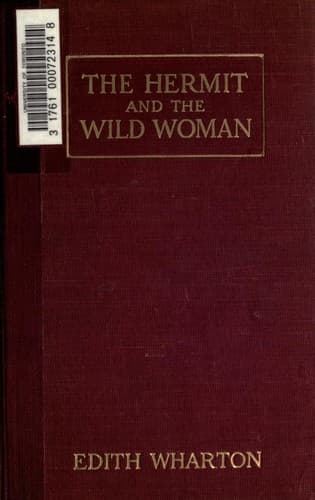
The Hermit and the Wild Woman, and Other StoriesWharton, Edith
General
The Hermit and the Wild Woman, and Other Stories
Wharton, Edith
Short stories, American
"Why, when he wants money, hang it!"
She drew a deep breath. "Money--money? Has Caspar's example been
nothing to you, then?"
"It hasn't proved to me that I must starve while Mungold lives on
truffles!"
Again her face changed and she stirred uneasily, and then rose to her
feet.
"There is no occasion which can justify an artist's sacrificing his
convictions!" she exclaimed.
Stanwell rose too, facing her with a mounting urgency which sent a
flush to his cheek.
"Can't you conceive such an occasion in my case? The wish, I mean, to
make things easier for Caspar--to help you in any way you might let me?"
Her face reflected his blush, and she stood gazing at him with a
wounded wonder.
"Caspar and I--you imagine we could live on money earned in _that_ way?"
Stanwell made an impatient gesture. "You've got to live on
something--or he has, even if you don't include yourself!"
Her blush deepened miserably, but she held her head high.
"That's just it--that's what I came here to say to you." She stood a
moment gazing away from him at the lake.
He looked at her in surprise. "You came here to say something to me?"
"Yes. That we've got to live on something, Caspar and I, as you say;
and since an artist cannot sacrifice his convictions, the sacrifice
must--I mean--I wanted you to know that I have promised to marry Mr.
Mungold."
"Mungold!" Stanwell cried with a sharp note of irony; but her white
look checked it on his lips.
"I know all you are going to say," she murmured, with a kind of
nobleness which moved him even through his sense of its grotesqueness.
"But you must see the distinction, because you first made it clear to
me. I can take money earned in good faith--I can let Caspar live on it.
I can marry Mr. Mungold; because, though his pictures are bad, he does
not prostitute his art."
She began to move away from him slowly, and he followed her in silence
along the frozen path.
When Stanwell re-entered his studio the dusk had fallen. He lit his
lamp and rummaged out some writing-materials. Having found them, he
wrote to Shepson to say that he could not paint Mrs. Van Orley, and did
not care to accept any more orders for the present. He sealed and
stamped the letter and flung it over the banisters for the janitor to
post; then he dragged out his unfinished head of Kate Arran, replaced
it on the easel, and sat down before it with a grim smile.
THE BEST MAN
I
DUSK had fallen, and the circle of light shed by the lamp of Governor
Mornway's writing-table just rescued from the surrounding dimness his
own imposing bulk, thrown back in a deep chair in the lounging attitude
habitual to him at that hour.
Public-domain text, read in full here on John Shaqi.
Reviews
Reviews
No reviews yet
Be the first to share your thoughts on this work.
Elsewhere in the archive
Join the Discussion
Join the discussion
Sign in to leave a comment or review.
Sign InorCreate an account