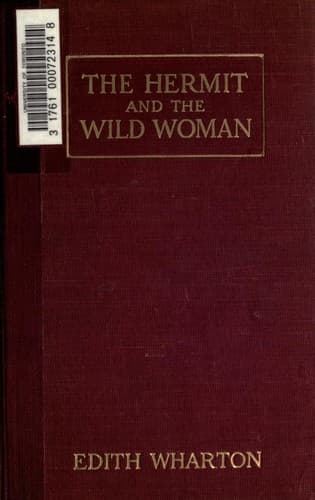
The Hermit and the Wild Woman, and Other StoriesWharton, Edith
General
The Hermit and the Wild Woman, and Other Stories
Wharton, Edith
Short stories, American
The wound in her foot healed slowly; and the Hermit, while it was
mending, repaired daily to her cave, reasoning with her in love and
charity, and exhorting her to return to the cloister. But this she
persistently refused to do; and fearing lest she attempt to fly before
her foot was healed, and so expose herself to hunger and ill-usage, he
promised not to betray her presence, or to take any measures toward
restoring her to her Order.
He began indeed to doubt whether she had any calling to the life
enclosed; yet her gentleness and innocency of mind made him feel that
she might be won back to holy living, if only her freedom were assured.
So after many inward struggles (since his promise forbade his taking
counsel with any concerning her) he resolved to let her remain in the
cave till some light should come to him. And one day, visiting her
about the hour of Nones (for it became his pious habit to say the
evening office with her), he found her engaged with a little goatherd,
who in a sudden seizure had fallen from a rock above her cave, and lay
senseless and full of blood at her feet. And the Hermit saw with wonder
how skilfully she bound up his cuts and restored his senses, giving him
to drink of a liquor she had distilled from the wild simples of the
mountain; whereat the boy opened his eyes and praised God, as one
restored by heaven. Now it was known that this lad was subject to
possessions, and had more than once dropped lifeless while he heeded
his flock; and the Hermit, knowing that only great saints or unclean
necromancers can loosen devils, feared that the Wild Woman had
exorcised the spirits by means of unholy spells. But she told him that
the goatherd's sickness was caused only by the heat of the sun, and
that, such seizures being common in the hot countries whence she came,
she had learned from a wise woman how to stay them by a decoction of
the _carduus benedictus_, made in the third night of the waxing moon,
but without the aid of magic.
"But," she continued, "you need not fear my bringing scandal on your
holy retreat, for by the arts of the same wise woman my own wound is
well-nigh healed, and tonight at sunset I set forth on my travels."
The Hermit's heart grew heavy as she spoke, and it seemed to him that
her own look was sorrowful. And suddenly his perplexities were lifted
from him, and he saw what was God's purpose with the Wild Woman.
"Why," said he, "do you fly from this place, where you are safe from
molestation, and can look to the saving of your soul? Is it that your
feet weary for the road, and your spirits are heavy for lack of worldly
discourse?"
She replied that she had no wish to travel, and felt no repugnance to
solitude. "But," said she, "I must go forth to beg my bread, since in
this wilderness there is none but yourself to feed me; and moreover,
when it is known that I have healed the goatherd, curious folk and
scandal-mongers may seek me out, and, learning whence I come, drag me
back to the cloister."
Public-domain text, read in full here on John Shaqi.
Reviews
Reviews
No reviews yet
Be the first to share your thoughts on this work.
Join the Discussion
Join the discussion
Sign in to leave a comment or review.
Sign InorCreate an account