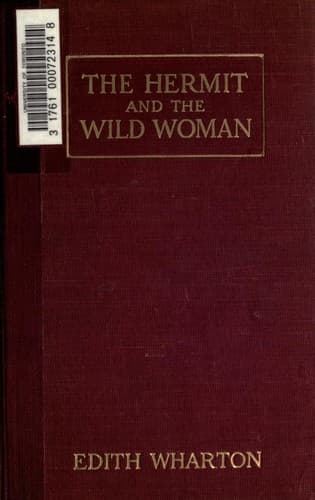
The Hermit and the Wild Woman, and Other StoriesWharton, Edith
General
The Hermit and the Wild Woman, and Other Stories
Wharton, Edith
Short stories, American
When he had accepted the position of "London correspondent" (with an
occasional side-glance at Paris) to the New York _Searchlight_, he had
not understood that his work was to include the obligation of
"interviewing"; indeed, had the possibility presented itself in
advance, he would have met it by unpacking his valise and returning to
the drudgery of his assistant-editorship in New York. But when, after
three months in Europe, he received a letter from his chief, suggesting
that he should enliven the Sunday _Searchlight_ by a series of "Talks
with Smart Americans in London" (beginning, say, with Mrs. Sam Newell),
the change of focus already enabled him to view the proposal without
passion. For his life on the edge of the great world-caldron of art,
politics and pleasure--of that high-spiced brew which is nowhere else
so subtly and variously compounded--had bred in him an eager appetite
to taste of the heady mixture. He knew he should never have the full
spoon at his lips, but he recalled the peasant-girl in one of
Browning's plays, who has once eaten polenta cut with a knife which has
carved an ortolan. Might not Mrs. Newell, who had so successfully cut a
way into the dense and succulent mass of English society, serve as the
knife to season his polenta?
He had expected, as the result of the interview, to which she promptly,
almost eagerly, assented, no more than the glimpse of brightly lit
vistas which a waiting messenger may catch through open doors; but
instead he had found himself drawn at once into the inner sanctuary,
not of London society, but of Mrs. Newell's relation to it. She had
been candidly charmed by the idea of the interview: it struck him that
she was conscious of the need of being freshened up. Her appearance was
brilliantly fresh, with the inveterate freshness of the toilet-table;
her paint was as impenetrable as armor. But her personality was a
little tarnished: she was in want of social renovation. She had been
doing and saying the same things for too long a time. London, Cowes,
Homburg, Scotland, Monte Carlo--that had been the round since Hermy was
a baby. Hermy was her daughter, Miss Hermione Newell, who was called in
presently to be shown off to the interviewer and add a paragraph to the
celebration of her mother's charms.
Miss Newell's appearance was so full of an unassisted freshness that
for a moment Garnett made the mistake of fancying that she could fill a
paragraph of her own. But he soon found that her vague personality was
merely tributary to her parent's; that her youth and grace were, in
some mysterious way, her mother's rather than her own. She smiled
obediently on Garnett, but could contribute little beyond her smile and
the general sweetness of her presence, to the picture of Mrs. Newell's
existence which it was the young man's business to draw. And presently
he found that she had left the room without his noticing it.
Public-domain text, read in full here on John Shaqi.
Reviews
Reviews
No reviews yet
Be the first to share your thoughts on this work.
Join the Discussion
Join the discussion
Sign in to leave a comment or review.
Sign InorCreate an account