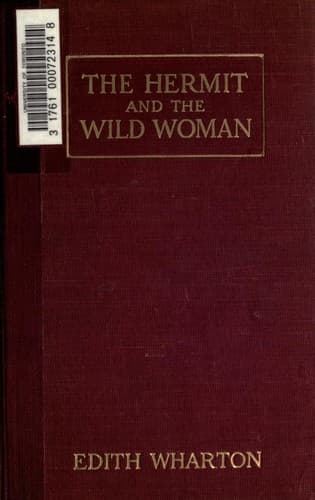
The Hermit and the Wild Woman, and Other StoriesWharton, Edith
General
The Hermit and the Wild Woman, and Other Stories
Wharton, Edith
Short stories, American
But his resistance only strengthened the young man's. The more
unpleasant the latter's task became, the more unwilling he grew to see
his efforts end in failure. During the three days which had been
consumed in his quest it had become clear to him that the bridegroom's
parents, having been surprised into a reluctant consent, were but too
ready to withdraw it on the plea of Mr. Newell's non-appearance. Mrs.
Newell, on the last edge of tension, had confided to Garnett that the
Morningfields were "being nasty"; and he could picture the whole
powerful clan, on both sides of the Channel, arrayed in a common
resolve to exclude poor Hermione from their ranks. The very inequality
of the contest stirred his blood, and made him vow that in this case at
least the sins of the parents should not be visited on the children. In
his talk with the young secretary he had obtained some glimpses of
Baron Schenkelderff's past which fortified this resolve. The Baron, at
one time a familiar figure in a much-observed London set, had been
mixed up in an ugly money-lending business ending in suicide, which had
excluded him from the society most accessible to his race. His alliance
with Mrs. Newell was doubtless a desperate attempt at rehabilitation, a
forlorn hope on both sides, but likely to be an enduring tie because it
represented, to both partners, their last chance of escape from social
extinction. That Hermione's marriage was a mere stake in their game did
not in the least affect Garnett's view of its urgency. If on their part
it was a sordid speculation, to her it had the freshness of the first
wooing. If it made of her a mere pawn in their hands, it would put her,
so Garnett hoped, beyond farther risk of such base uses; and to achieve
this had become a necessity to him.
The sense that, if he lost sight of Mr. Newell, the latter might not
easily be found again, nerved Garnett to hold his ground in spite of
the resistance he encountered; and he tried to put the full force of
his plea into the tone with which he cried: "Ah, you don't know your
daughter!"
VI
MRS. NEWELL, that afternoon, met him on the threshold of her
sitting-room with a "Well?" of pent-up anxiety.
In the room itself, Baron Schenkelderff sat with crossed legs and head
thrown back, in an attitude which he did not see fit to alter at the
young man's approach.
Garnett hesitated; but it was not the summariness of the Baron's
greeting which he resented.
"You've found him?" Mrs. Newell exclaimed.
"Yes; but--"
She followed his glance and answered it with a slight shrug. "I can't
take you into my room, because there's a dress-maker there, and she
won't go because she is waiting to be paid. Schenkelderff," she
exclaimed, "you're not wanted; please go and look out of the window."
The Baron rose and, lighting a cigarette, laughingly retired to the
embrasure. Mrs. Newell flung herself down and signed to Garnett to take
a seat at her side.
"Well--you've found him? You've talked with him?"
Public-domain text, read in full here on John Shaqi.
Reviews
Reviews
No reviews yet
Be the first to share your thoughts on this work.
Join the Discussion
Join the discussion
Sign in to leave a comment or review.
Sign InorCreate an account