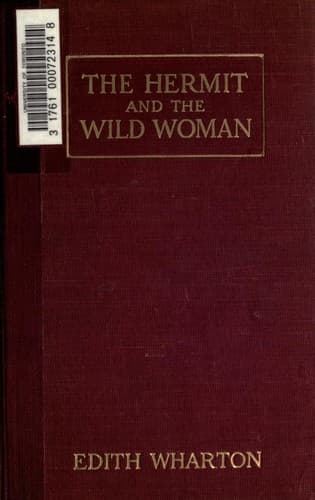
The Hermit and the Wild Woman, and Other StoriesWharton, Edith
General
The Hermit and the Wild Woman, and Other Stories
Wharton, Edith
Short stories, American
When she reached home Ransom had not yet returned from the office, and
she went straight to the library to tidy his writing-table. It was part
of her daily duty to bring order out of the chaos of his papers, and of
late she had fastened on such small recurring tasks as some one falling
over a precipice might snatch at the weak bushes in its clefts.
When she had sorted the letters she took up some pamphlets and
newspapers, glancing over them to see if they were to be kept. Among
the papers was a page torn from a London _Times_ of the previous month.
Her eye ran down its columns and suddenly a paragraph flamed out.
"We are requested to state that the marriage arranged between Mr. Guy
Dawnish, son of the late Colonel the Hon. Roderick Dawnish, of Malby,
Wilts, and Gwendolen, daughter of Samuel Matcher, Esq. of Armingham
Towers, Wilts, will not take place."
Margaret dropped the paper and sat down, hiding her face against the
stained baize of the desk. She remembered the photograph of the
tennis-court at Guise--she remembered the handsome girl at whom Guy
Dawnish looked up, laughing. A gust of tears shook her, loosening the
dry surface of conventional feeling, welling up from unsuspected
depths. She was sorry--very sorry, yet so glad--so ineffably,
impenitently glad.
V
THERE came a reaction in which she decided to write to him. She even
sketched out a letter of sisterly, almost motherly, remonstrance, in
which she reminded him that he "still had all his life before him." But
she reflected that so, after all, had she; and that seemed to weaken
the argument.
In the end she decided not to send the letter. He had never spoken to
her of his engagement to Gwendolen Matcher, and his letters had
contained no allusion to any sentimental disturbance in his life. She
had only his few broken words, that night by the river, on which to
build her theory of the case. But illuminated by the phrase "an
unfortunate attachment" the theory towered up, distinct and immovable,
like some high landmark by which travellers shape their course. She had
been loved--extraordinarily loved. But he had chosen that she should
know of it by his silence rather than by his speech. He had understood
that only on those terms could their transcendant communion
continue--that he must lose her to keep her. To break that silence
would be like spilling a cup of water in a waste of sand. There would
be nothing left for her thirst.
Public-domain text, read in full here on John Shaqi.
Reviews
Reviews
No reviews yet
Be the first to share your thoughts on this work.
Elsewhere in the archive
Join the Discussion
Join the discussion
Sign in to leave a comment or review.
Sign InorCreate an account