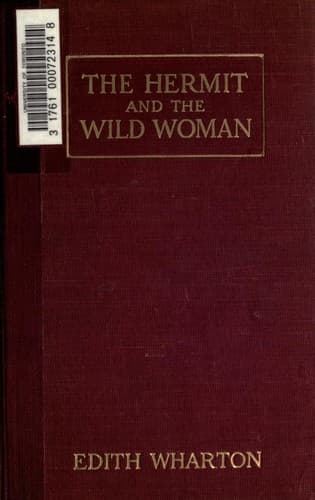
The Hermit and the Wild Woman, and Other StoriesWharton, Edith
General
The Hermit and the Wild Woman, and Other Stories
Wharton, Edith
Short stories, American
Her life, thenceforward, was bathed in a tranquil beauty. The days
flowed by like a river beneath the moon--each ripple caught the
brightness and passed it on. She began to take a renewed interest in
her familiar round of duties. The tasks which had once seemed
colourless and irksome had now a kind of sacrificial sweetness, a
symbolic meaning into which she alone was initiated. She had been
restless--had longed to travel; now she felt that she should never
again care to leave Wentworth. But if her desire to wander had ceased,
she travelled in spirit, performing invisible pilgrimages in the
footsteps of her friend. She regretted that her one short visit to
England had taken her so little out of London--that her acquaintance
with the landscape had been formed chiefly through the windows of a
railway carriage. She threw herself into the architectural studies of
the Higher Thought Club, and distinguished herself, at the spring
meetings, by her fluency, her competence, her inexhaustible curiosity
on the subject of the growth of English Gothic. She ransacked the
shelves of the college library, she borrowed photographs of the
cathedrals, she pored over the folio pages of "The Seats of Noblemen
and Gentlemen." She was like some banished princess who learns that she
has inherited a domain in her own country, who knows that she will
never see it, yet feels, wherever she walks, its soil beneath her feet.
May was half over, and the Higher Thought Club was to hold its last
meeting, previous to the college festivities which, in early June,
agreeably disorganized the social routine of Wentworth. The meeting was
to take place in Margaret Ransom's drawing-room, and on the day before
she sat upstairs preparing for her dual duties as hostess and
orator--for she had been invited to read the final paper of the course.
In order to sum up with precision her conclusions on the subject of
English Gothic she had been rereading an analysis of the structural
features of the principal English cathedrals; and she was murmuring
over to herself the phrase: "The longitudinal arches of Lincoln have an
approximately elliptical form," when there came a knock on the door,
and Maria's voice announced: "There's a lady down in the parlour."
Margaret's soul dropped from the heights of the shadowy vaulting to the
dead level of an afternoon call at Wentworth.
"A lady? Did she give no name?"
Maria became confused. "She only said she was a lady--" and in reply to
her mistress's look of mild surprise: "Well, ma'am, she told me so
three or four times over."
Margaret laid her book down, leaving it open at the description of
Lincoln, and slowly descended the stairs. As she did so, she repeated
to herself: "The longitudinal arches are elliptical."
Public-domain text, read in full here on John Shaqi.
Reviews
Reviews
No reviews yet
Be the first to share your thoughts on this work.
Elsewhere in the archive
Join the Discussion
Join the discussion
Sign in to leave a comment or review.
Sign InorCreate an account