Note: Images of the original pages are available through
Internet Archive/American Libraries. See
http://archive.org/details/heroineb00barr
Transcriber's note:
Text enclosed by underscores is in italics (_italics_).
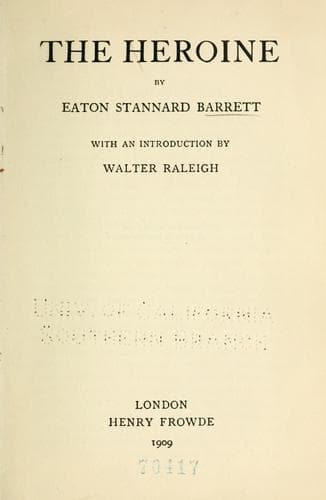
THE HEROINE
by
EATON STANNARD BARRETT
With an Introduction by Walter Raleigh
London
Henry Frowde
1909
Oxford: Horace Hart
Printer to the University
INTRODUCTION
'In Glamorganshire, of a rapid decline, occasioned by the bursting of a
blood-vessel, Eaton Stannard Barrett, esq., a native of Ireland, and a
student of the Middle Temple. He published "All the Talents", a Poem,
8vo. 1817.--"The Comet", a mock newspaper, 8vo. 1803.--A very pleasing
poem intituled "Woman", 8vo. 1810.--"The Heroine, or Adventures of
Cherubina", 3 vols. 12mo, 2d. edit. 1814. This volume is said to abound
in wit and humour.'
Very little can now be added to this obituary notice, which appeared
in the __ for April, 1820. The young Irishman whose death it records
was born at Cork in 1786, received his education chiefly in London,
addicted himself to the law, and was early diverted into the
profession of letters, which he practised with great energy and
versatility. Besides the works mentioned above, he wrote a serio-comic
romance called _The Rising Sun_, and a farcical comedy, full of noise
and bustle, called _My Wife, What Wife?_ The choice of this last
phrase (sacred, if any words in poetry are sacred) for the title of a
rollicking farce indicates a certain bluntness of sensibility in the
author. He was young, and fell head over ears in love with cleverness;
he was a law-student, and took to political satire as a duck takes to
the rain; he was an Irishman, and found himself the master of a happy
Irish wit, clean, quick, and dainty, but no ways searching or
profound. At the back of all his satire there lies a simple social
creed, which he accepts from the middle-class code of his own time,
and does not question. The two of his works which achieved something
like fame, _Woman, a Poem_, and _The Heroine_, here reprinted, set
forth that creed, describing the ideal heroine in verse, and warning
her, in prose, against the extravagances that so easily beset her. The
mode in female character has somewhat changed since George was king,
and the pensive coyness set up as a model in the poem seems to a
modern reader almost as affected as the vagaries described in the
novel. Yet the poem has all the interest and brilliancy of an old
fashion-plate. Here is woman as she wished to be in the days of the
Regency, or perhaps as man wished her to be, for it is impossible to
say which began it. Both gloried in the contrast of their habits. If
man, in that age of the prize-ring and the press-gang, was
pre-eminently a drinking, swearing, fighting animal, his indelicacy
was redeemed by the shrinking graces of his mate.
For woman is not undevelopt man,
But diverse:
Public-domain text, read in full here on John Shaqi.
Reviews
Reviews
No reviews yet
Be the first to share your thoughts on this work.
Join the Discussion
Join the discussion
Sign in to leave a comment or review.
Sign InorCreate an account