well-worded prayer.'
The notable thing is that this attack on the novels of the day was not
an isolated protest; it expressed the general mind and echoed the
current opinion. Miss Austen, with more suavity and art, had long
before said the same thing. The romance was declining; it had become a
cheap mechanical thing; and the mind of the nation was turning away
from it to reinstate those teachers of moral prudence whose influence
had been impaired by the flood, but not destroyed. If any one had been
rash enough, in the year 1814, to prophesy the future of literature, he
would have been justified in saying that, to all appearances, the prose
romance was dead. It had fallen into its dotage, and the hand of Eaton
Stannard Barrett had killed it. _The Heroine_ seemed to mark the end
of an age of romance, and the beginning of a new era of sententious
prose.
Such a prophet would have been approved by _The Edinburgh Review_ and
all the best judges of the time. He would have been wrong, for he
could not foresee the accident of genius. Walter Scott, like Cherubina
(whose adventures he read and applauded), had fallen a victim to the
fascinations of the writers of romance, yet, unlike her, had not
allowed them to deprive him of all acquaintance with 'a more useful
class of composition' and the toils of active life. Romance was what
he cared for, and he brought the sobriety and learning of a judge to
the task of vindicating his affection. He proved that the old romantic
stories are convincing enough if only the blood of life flows through
them. His great panoramas of history are exhibited in the frame-work
of a love-plot. In place of the feeble comic interest of the earlier
romances he supplied a rich and various tissue of national character
and manners. Ancient legend and song, fable and superstition, live
again in his work. And, as if Cherubina's unhappy experiences had all
been in vain, there is always a heroine. The readers who had been
laughed into scepticism by the wit of the enemy were within a few
years won back to poetry and romance; Cherubina was deposed, and in
her place there reigned the Bride of Lammermoor.
WALTER RALEIGH.
OXFORD,
_Christmas, 1908._
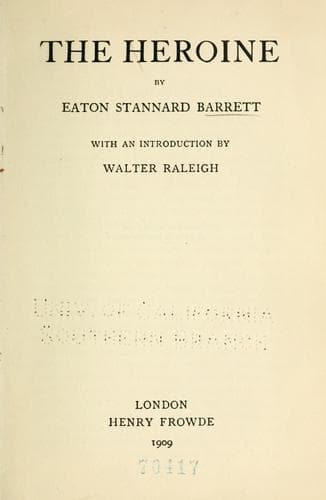
THE HEROINE,
OR
ADVENTURES OF A FAIR ROMANCE READER,
BY
EATON STANNARD BARRETT, ESQ.
* * * * *
"L'Histoire d'une femme est toujours un Roman."
* * * * *
_IN THREE VOLUMES._
VOL. I.
* * * * *
LONDON:
PRINTED FOR HENRY COLBURN,
PUBLIC LIBRARY, CONDUIT-STREET, HANOVER-SQUARE;
AND SOLD BY GEORGE GOLDIE, EDINBURGH,
AND JOHN CUMMING, DUBLIN.
1813.
TO THE RIGHT HONORABLE GEORGE CANNING &c. &c. &c.
Sir,
It was the happiness of STERNE to have dedicated his volumes to a
PITT. It is my ambition to inscribe this work to you. My wishes
would be complete, could I resemble the writer as you do the
statesman.
I have the honor to be,
Public-domain text, read in full here on John Shaqi.
Reviews
Reviews
No reviews yet
Be the first to share your thoughts on this work.
Join the Discussion
Join the discussion
Sign in to leave a comment or review.
Sign InorCreate an account