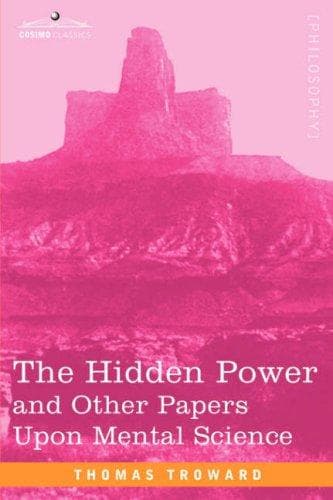
The Hidden Power, and Other Papers upon Mental ScienceTroward, T. (Thomas)
Religion
The Hidden Power, and Other Papers upon Mental Science
Troward, T. (Thomas)
New Thought
The ideal is the true real, but it must be brought into manifestation
before it can be shown to be so, and it is in this that the _practical_
nature of our mental studies consists. It is the _practical_ mystic who
is the man of power; the man who, realising the mystical powers within,
fits his outward action to this knowledge, and so shows his faith by his
works; and assuredly the first step is to make use of that power of
infallible guidance which he can call to his aid simply by desiring to
be led by it.
VIII
DESIRE AS THE MOTIVE POWER
There are certain Oriental schools of thought, together with various
Western offshoots from them, which are entirely founded on the principle
of annihilating all desire. Reach that point at which you have no wish
for anything and you will find yourself free, is the sum and substance
of their teaching; and in support of this they put forward a great deal
of very specious argument, which is all the more likely to entangle the
unwary, because it contains a recognition of many of the profoundest
truths of Nature. But we must bear in mind that it is possible to have a
very deep knowledge of psychological facts, and at the same time vitiate
the results of our knowledge by an entirely wrong assumption in regard
to the law which binds these facts together in the universal system; and
the injurious results of misapprehension upon such a vital question are
so radical and far-reaching that we cannot too forcibly urge the
necessity of clearly understanding the true nature of the point at
issue. Stripped of all accessories and embellishments, the question
resolves itself into this: Which shall we choose for our portion, Life
or Death? There can be no accommodation between the two; and whichever
we select as our guiding principle must produce results of a kind proper
to itself.
The whole of this momentous question turns on the place that we assign
to desire in our system of thought. Is it the Tree of Life in the midst
of the Garden of the Soul? or is it the Upas Tree creating a wilderness
of death all around? This is the issue on which we have to form a
judgment, and this judgment must colour all our conception of life and
determine the entire range of our possibilities. Let us, then, try to
picture to ourselves the ideal proposed by the systems to which I have
alluded--a man who has succeeded in entirely annihilating all desire. To
him all things must be alike. The good and the evil must be as one, for
nothing has any longer the power to raise any desire in him; he has no
longer any feeling which shall prompt him to say, "This is good,
therefore I choose it; that is evil, therefore I reject it"; for all
choice implies the perception of something more desirable in what is
chosen than in what is rejected, and consequently the existence of that
feeling of desire which has been entirely eliminated from the ideal we
are contemplating.
Public-domain text, read in full here on John Shaqi.
Reviews
Reviews
No reviews yet
Be the first to share your thoughts on this work.
Join the Discussion
Join the discussion
Sign in to leave a comment or review.
Sign InorCreate an account