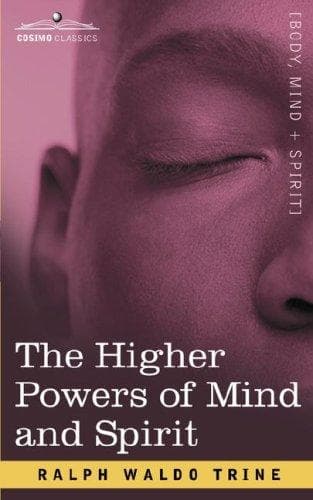
The Higher Powers of Mind and SpiritTrine, Ralph Waldo
Religion
The Higher Powers of Mind and Spirit
Trine, Ralph Waldo
Mind and body; New Thought
If one would have friends he or she must be a friend, must radiate
habitually friendly, helpful thoughts, good will, love. The one who
doesn't cultivate the hopeful, cheerful, uncomplaining, good-will
attitude toward life and toward others becomes a drag, making life
harder for others as well as for one's self.
Ordinarily we find in people the qualities we are mostly looking for, or
the qualities that our own prevailing characteristics call forth. The
larger the nature, the less critical and cynical it is, the more it is
given to looking for the best and the highest in others, and the less,
therefore, is it given to gossip.
It was Jeremy Bentham who said: "In order to love mankind, we must not
expect too much of them." And Goethe had a still deeper vision when he
said: "Who is the happiest of men? He who values the merits of others,
and in their pleasure takes joy, even as though it were his own."
The chief characteristic of the gossip is that he or she prefers to live
in the low-lying miasmic strata of life, revelling in the negatives of
life and taking joy in finding and peddling about the findings that he
or she naturally makes there. The larger natures see the good and
sympathise with the weaknesses and the frailties of others. They realise
also that it is so consummately inconsistent--many times even humorously
inconsistent--for one also with weaknesses, frailties, and faults,
though perhaps of a little different character, to sit in judgment of
another. Gossip concerning the errors or shortcomings of another is
judging another. The one who is himself perfect is the one who has the
right to judge another. By a strange law, however, though by a natural
law, we find, as we understand life in its fundamentals better, such a
person is seldom if ever given to judging, much less to gossip.
Life becomes rich and expansive through sympathy, good will, and good
cheer; not through cynicism or criticism. That splendid little poem of
but a single stanza by Edwin Markham, "Outwitted," points after all to
one of life's fundamentals:
He drew a circle that shut me out--
Heretic, rebel, a thing to flout,
But Love and I had the wit to win:
We drew a circle that took him in!
VI
JESUS THE SUPREME EXPONENT OF THE INNER FORCES AND POWERS: HIS PEOPLE'S
RELIGION AND THEIR CONDITION
In order to have any true or adequate understanding of what the real
revelation and teachings of Jesus were, two things must be borne in
mind. It is necessary in the first place, not only to have a knowledge
of, but always to bear in mind the method, the medium through which the
account of his life has come down to us. Again, before the real content
and significance of Jesus' revelation and teachings can be intelligently
understood, it is necessary that we have a knowledge of the conditions
of the time in which he lived and of the people to whom he spoke, to
whom his revelation was made.
Public-domain text, read in full here on John Shaqi.
Reviews
Reviews
No reviews yet
Be the first to share your thoughts on this work.
Join the Discussion
Join the discussion
Sign in to leave a comment or review.
Sign InorCreate an account