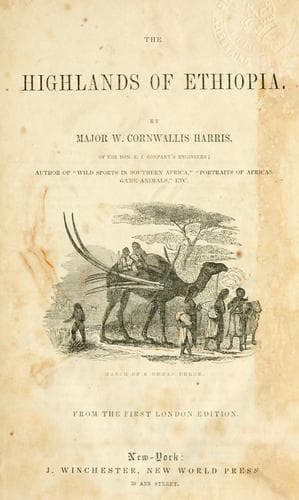
The Highlands of EthiopiaHarris, William Cornwallis, Sir
History
The Highlands of Ethiopia
Harris, William Cornwallis, Sir
Ethiopia -- Description and travel
A burst of savage acclamation, which rose shrill and high in the
noontide heat from the assembled population, was succeeded by a solemn
pause as the dread tidings were imparted to the relatives of the fallen.
A path was cleared through the now hushed and silent phalanx, whilst
muffled females, beating their bare breasts, passed towards the biers
between the open ranks. The boldest and the bravest had been untimely
cut off; and their widows, throwing themselves upon the lifeless bodies,
indulged for a season in the most piercing shrieks and extravagant
grief. But the deep loud chaunt of the elders, "It is the decree of the
Most High," drowned the hysterical sobs of the bereaved; and the host
again moved on in boisterous mirth to indulge, after the successful
foray, according to the bent of their inclinations, and prepare for a
series of achievements, which have since cleared the surrounding plains.
To this day none but the boldest dare, after nightfall, to enter the
valley of skulls. The moans of the Galeyla warriors who fell in the
affray are heard amidst the funereal sighing of the wind; the plaintive
song of the Bedouin maid still chronicles the event; and long will be
remembered in the red house of Mudaito the night of the massacre of
Gootabella.
Volume One, Chapter XXI.
SANKUL, AND SUGGAGEDAN. DAWAYLAKA AND AMADOO IN THE LIMITS OF THE
GALEYLA MUDAITO.
Ascending by an extremely bad road the broken range to the southward,
which commands a fine prospect over the valley of Gobaad, the kafilah
reached Sankul on the 17th. It forms the focus of several small dales
converging from the table-land, and shut in from all breeze by the
surrounding steep black cliffs of basalt, passing into hornblende. A
small cave near the encamping ground was occupied by a colony of
industrious bees, and at the only well, flocks of the diminutive
black-faced Berbera sheep were drinking from a trough formed of an
ox-hide stretched between four stakes, to which the water was
transferred in gourds by greasy Bedouin shepherdesses. The evening was
passed in perpetual wrangling with these matrons during the operation of
filling up the water-skins; and sad presage was afforded of a coming day
of drought, which the exhausted and sinking cattle of the caravan were
hourly waxing less able to endure.
Public-domain text, read in full here on John Shaqi.
Reviews
Reviews
No reviews yet
Be the first to share your thoughts on this work.
Elsewhere in the archive
Join the Discussion
Join the discussion
Sign in to leave a comment or review.
Sign InorCreate an account