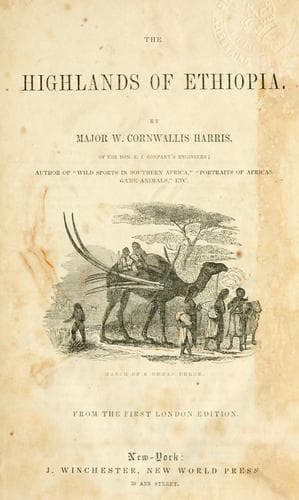
The Highlands of EthiopiaHarris, William Cornwallis, Sir
History
The Highlands of Ethiopia
Harris, William Cornwallis, Sir
Ethiopia -- Description and travel
Basaltic and trachytic hills, either isolated or in chains, rise at a
distance of about half a mile from the sea-shore, which is winding and
shelving. The hills are in general rounded, and marked by broad veins
of similar composition, but containing more perfectly crystallised
felspar, quartz, and zeolith. They have not the sharp peak, but are
broken and cliffy, and have apparently been upheaved at different
periods.
On leaving the shore, a most striking specimen of columnar basalt
presented itself in the ravine of Galeylafeo, which, for nearly half a
mile, runs through the heart of a huge mountain. In width it is about
200 yards, and the perpendicular pillars are 200 feet in height. It is
evident that water could not have been the sole agent in producing such
a huge cleft, although at present the ravine presents the appearance of
a regular water-course. The surrounding hills consist of the same rock,
but covered with loose boulders, which are much stained with oxide of
iron.
Amongst the confusion of volcanic masses on the plain of Warelissan,
excepting in some rare cases, when the true lava stream could be traced
to its source, it was difficult to determine the exact site of the
craters from whence they had been ejected. The hill which separates
Bahr Assai from the sea, with its singular tops of limestone, slate, and
creta, deserves a more minute examination than could be given at this
season of withering heat. The western side is the most interesting, as
being more open and disclosed; there is, however, as in all formations
in the vicinity of volcanic countries, no uniform inclination of the
layers. The range bordering the eastern shore of the lake is basalt and
basaltic wacke; on the western, it is partly gypsum and limestone, but
resting on basalt.
Public-domain text, read in full here on John Shaqi.
Reviews
Reviews
No reviews yet
Be the first to share your thoughts on this work.
Elsewhere in the archive
Join the Discussion
Join the discussion
Sign in to leave a comment or review.
Sign InorCreate an account