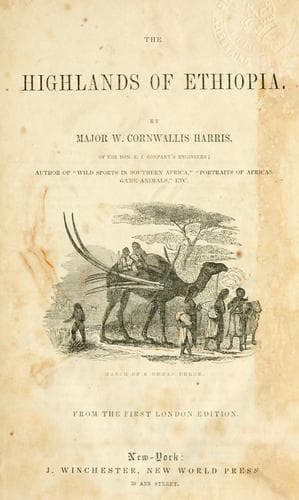
The Highlands of EthiopiaHarris, William Cornwallis, Sir
History
The Highlands of Ethiopia
Harris, William Cornwallis, Sir
Ethiopia -- Description and travel
The great salt lake is a deep extensive basin, separated by an immense
lava stream from the remainder of the bay, the head of which it once
formed. Resembling the Dead Sea in the depression of its level, in the
density and chemical constitution of the fluid, and in the loneliness,
sterility, and desolation of its borders, it yet differs from it
materially in the ways by which volcanic action has produced the strange
phenomenon of the existence of shores so considerably below the level of
the ocean. In the Dead Sea, the lake of Tiberias, and the valley of the
Jordan between them, it has apparently been a distortion and crushing of
immense masses which have subsided into subterranean caverns. In the
Bahr Assai it has been produced by the erection of a new bank, serving
as a dam or barrier across the head of a long narrow bay, by which a
considerable body of sea-water was separated from the former common
receptacle. As high as the level of the Arabian Gulf are to be found,
in the basin of Bahr Assai, the salts and earthy (magnesian)
precipitates of the salt water, which in the course of time was reduced
to its present level by evaporation, the yearly supply of rain-water
being but as a drop to the ocean. Huge heaps of lava, having been
apparently in strife with the opposite element, are erected on the banks
over wacke, or in other cases over a finely-grained soft mart. The
latter, when clear of lava, presents a thin layer of gypsum, with
numerous shells of Melania, Limnaeus, Physa, Planorbis, Cyclostoma,
Unio, and Cycas, some of which are at present to be found in the distant
fresh-water pools and rivulets.
The shallow water on the borders of the lake presents natural salt-pans,
and a crust of fine salt, two inches thick and tolerably clean, covers
nearly the whole of the surface. The supply would seem to be
inexhaustible; for when cut out with a spaddle, a new crust is soon
furnished from the waters beneath. Being visited by almost every tribe
of the Adaiel and Somauli, and unhappily situated on the borders of the
most lawless and savage of them, this remarkable spot is almost
forbidden ground for the observer, not to speak of the obstacles thrown
in the way by the destructive temperature and the general absence of the
necessaries of life.
In the ravine of Goongoonteh, and during the continuation of the journey
as far as Killulloo, slight variations of trap formation were met with.
The wacke is of a fine grain, and its constituents are indistinctly
mingled; it is traversed by empty holes and bubbles, and occasionally by
druses of zeolith. Coarse quartz, sandstone, and conglomerates are
sometimes found towards the surface. The country must have frequently
been agitated by violent earthquakes, detaching huge masses of rocks
from the hills; and, bereft alike of vegetation and animal life, it
presents altogether a most monotonous appearance.
Public-domain text, read in full here on John Shaqi.
Reviews
Reviews
No reviews yet
Be the first to share your thoughts on this work.
Elsewhere in the archive
Join the Discussion
Join the discussion
Sign in to leave a comment or review.
Sign InorCreate an account