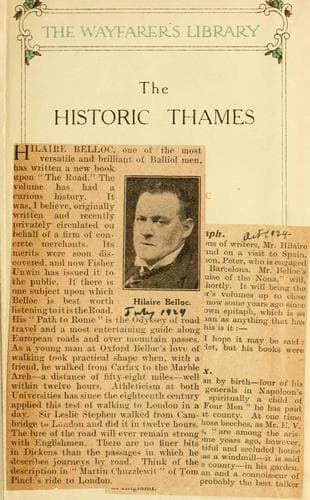
Historic sites -- England -- Thames Valley; Thames Valley (England) -- Description and travel; Thames Valley (England) -- History
Cricklade, as we have seen, is a perfectly well-established site, and
we owe our certitude upon the matter to the fact that the Romans had
hardened and straightened what was probably an old British track. But
with the crossing of the Icknield Way no such complete certitude
exists, for the Icknield Way was but a vague barbarian track, often
tortuous in outline, confused by branching ways, and presenting all
the features of a savage trail. Doubtless that trail was used during
the four hundred years of the high Roman civilisation as a country
road, just as the similar trail, known as the "Pilgrims' Way" from
Winchester to Canterbury, was used in the same epoch. There are plenty
of Roman remains to be found along the track, and there is no doubt
that all such roads, even when the State was not at the expense of
hardening or straightening them, were in continual use before, as they
were in continual use after, the presence of Roman government in this
island; but the Icknield Way does not approach the river in a clear
and unmistakable manner as would a Roman or a Romanised road. It is on
this account that the exact point of its crossing has been debated.
The problem is roughly this: the high and treeless chalk downs have
been used from the beginning of human habitation in these islands as
the principal highways, and any single traveller or tribe that desired
in early times to get from the Hampshire highlands to the east and
north of England must have begun by following the ridge of the
Berkshire Hills, and by continuing along the dry upland of the
Chiltern Hills, which continue this reach beyond the Thames. But the
spot at which the pre-historic crossing of the Thames was effected
cannot be determined by a simple survey of the place where the Thames
cuts through the chalk range. Wallingford up above this gorge has
certain claims, both because it was the lowest of the continually
practicable fords upon the river, and because its whole history points
to an immemorial antiquity. Higher still, Dorchester, on which every
historian of the Thames must dwell as perhaps the most interesting of
all the settlements upon the banks of the river, has also been
suggested. Just above Dorchester, on the Berkshire side, stands the
peculiar isolated twin height which forms so conspicuous a landmark
when one gazes over the plain from the summit of the Downs. Such
landmarks often helped to trace the old roads. And Dorchester has also
an immemorial antiquity--a pre-historic fortification upon the hills
above, and fortifications, probably historic, on the Oxford bank
below, but Dorchester has no ford.
When all the evidence is weighed it seems more probable that the
regular crossing from the Berkshire Hills to the Chilterns was
effected at Streatley.
Public-domain text, read in full here on John Shaqi.
Reviews
Reviews
No reviews yet
Be the first to share your thoughts on this work.
Join the Discussion
Join the discussion
Sign in to leave a comment or review.
Sign InorCreate an account