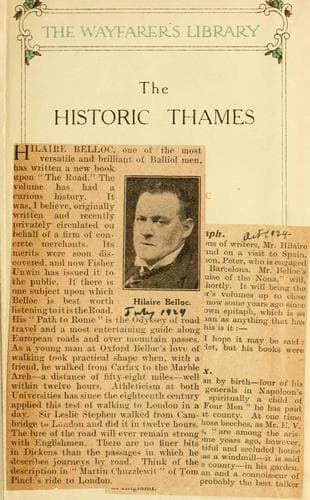
Historic sites -- England -- Thames Valley; Thames Valley (England) -- Description and travel; Thames Valley (England) -- History
The whole history of the Tower is the history of military misfortune,
which grows as London expands in numbers and prosperity. It probably
held out under Mandeville when the Londoners (who were always the
allies of the aristocracy against the national government) besieged it
under the civil wars of Stephen; but even so there was bad luck
attached to it, for when Mandeville was taken prisoner he was
compelled to sign its surrender. Within a generation Longchamp again
surrendered it to the young Prince John; he was for the moment leading
the aristocracy, which, when it was his turn to reign, betrayed him.
It was surrendered to the baronial party by the King as a trust or
pledge for the execution of Magna Charta, and though it was put into
the hands of the Archbishop, who was technically neutral, it was from
that moment the symbol of a successful rebellion, as it had already
proved to be in the past and was to prove so often again.
It was handed over to Louis of France upon his landing, and during the
next reign almost every misfortune of Henry III. is connected with the
Tower. He was perpetually taking refuge in it, holding his Court in
it: losing it again, as the rebels succeeded, and regaining it as they
failed. This long and unfortunate tenure of his is illumined only by
one or two delightful phrases which one cannot but retain as one
reads. Thus there is the little written order, which still remains to
us for the putting of painted windows into the Chapel of St John, the
northern one of which was to have for its design "some little Mary or
other, holding her Child"--"quandam Mariolam tenenten puerum suum."
There is also a very pleasing legend in the same year, 1241, when the
fall of certain new buildings was ascribed to the action of St.
Thomas, who was seen by a priest in a dream upsetting them with his
crozier and saying that he did this "as a good citizen of London,
because these new buildings were not put up for the defence of the
realm but to overawe the town," and he added this charming remark: "If
I had not undertaken the duty myself St. Edward or another would have
done it."
Even when Henry's misfortunes were at an end, and when the Battle of
Evesham was won, the Tower was perpetually unfortunate. A body of
rebels surrounded it, and in the defence were present a great number
of Jews, who had fled from the fighting in the city only to find
themselves pressed for service in defence of the fortress. From that
moment they make no further appearance in English military history
till the South African War, unless indeed their appearance in chains
thirteen years later in this same Tower as prisoners for financial
trickery can be counted a military event.
Public-domain text, read in full here on John Shaqi.
Reviews
Reviews
No reviews yet
Be the first to share your thoughts on this work.
Join the Discussion
Join the discussion
Sign in to leave a comment or review.
Sign InorCreate an account