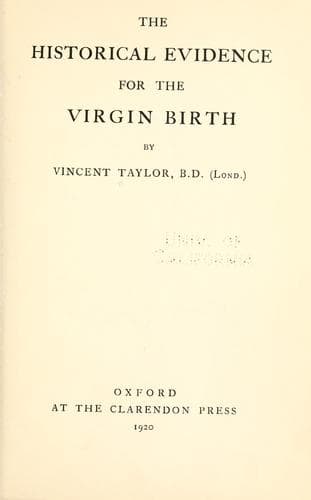
The Historical Evidence for the Virgin BirthTaylor, Vincent
Religion
The Historical Evidence for the Virgin Birth
Taylor, Vincent
Bible. Gospels; Jesus Christ -- Nativity; Virgin birth
22 “Few would say, with Westcott, that virgin‐birth is implied though
not explicitly asserted in Jn. i. 14....” (Mackintosh, ib., p. 528).
23 The view that i. 13 should be read “Who was born, &c.”, is that of
Resch, Blass, and Th. Zahn. The reading appears in Tertullian,
Irenaeus, Justin, but the weight of textual authority is against it.
Nor is the reading, as representing what the Evangelist wrote,
intrinsically probable. It would rule out the maternity of Mary as
well as the paternity of Joseph. The birth would not only be not “of
the will of man”; it would not even be “of blood”. There would be
nothing human about it; from first to last it would be “of God”. In
short, the reading leads directly to that docetic view of the Person
of Christ, against which the Johannine Writings so earnestly
contend. The same objection may be urged against the view that, in
the accepted text of Jn. i. 13, the Virgin Birth is present to the
writer’s mind “as a kind of pattern or model of the birth of the
children of God” (W. C. Allen, _Interpreter_, Oct., 1905. Cf. Orr,
op. cit., p. 111 f.; Box, op. cit., p. 145). Would not the Fourth
Evangelist have regarded such a comparison as almost a denial that
Jesus Christ is come in the flesh? Harnack has recently contended
for the singular and for a reference to the Virgin Birth. He thinks
that the verse was added in the margin, as a comment on i. 14, at a
very early time and in the Johannine circle (Peake, _Commentary on
the Bible_, p. 747 a).
24 Cf. Sanday, op. cit., pp. 71, 143‐55; Moffatt, INT., pp. 533 ff.; E.
F. Scott, _The Fourth Gospel, Its Purpose and Theology_, pp. 32 ff.;
Jülicher, INT., p. 396 f.
25 iv. 44 (“For Jesus himself testified, that a prophet hath no honour
in his own country”), unless it is a gloss, probably refers to
Judaea, not Galilee. Cf. Moffatt, INT., p. 553. Mr. Thompson argues
that it refers to Galilee (op. cit., p. 158).
26 “In order to explain his silence, we must remember his strict
exclusion of all that might imply a passivity in the divine Logos.
It was by His own free act that the Son of God entered the world as
man. The evangelist shrank from any theory of His origin that might
impair the central idea of full activity, from the beginning of His
work to the end” (Scott, ib., p. 187).
27 According to Cheyne (_Bible Problems_, pp. 76 ff.), the chapter
contains a Jewish Messianic legend of Babylonian origin, which was
the source of the Virgin Birth tradition.
28 The passage which begins with the words: “And Mary said unto the
angel, How shall this be, seeing I know not a man?”
29 Or was taken from Q. See Harnack’s _Sayings_, p. 314; _Oxford
Studies in Synoptic Problem_, p. 187.
30 EB., col. 2955 n. Cf. Plummer, ICC., St. Lk., p. 63.
Public-domain text, read in full here on John Shaqi.
Reviews
Reviews
No reviews yet
Be the first to share your thoughts on this work.
Elsewhere in the archive
Join the Discussion
Join the discussion
Sign in to leave a comment or review.
Sign InorCreate an account