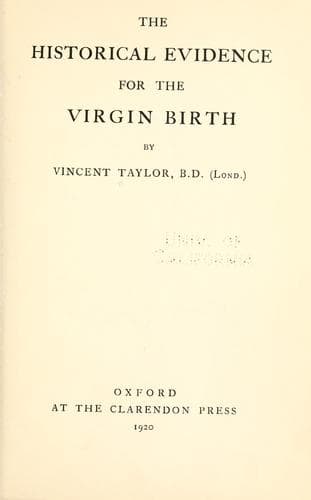
The Historical Evidence for the Virgin BirthTaylor, Vincent
Religion
The Historical Evidence for the Virgin Birth
Taylor, Vincent
Bible. Gospels; Jesus Christ -- Nativity; Virgin birth
31 In this connexion it should be observed that the same note of wonder
appears in ii. 18 in the case of all those who hear the shepherds’
words. But according to the terms of ii. 17, what _they_ are told is
the angelic message of ii. 10‐12, in which the Virgin Birth is not
mentioned. The presumption is that ii. 33 stands upon the same
plane.
32 So among others Schmiedel, Usener, Häcker, and Blass, who writes
(op. cit., p. 171 n.): “ ‘The espoused wife’ of the ordinary text is
a very clear corruption, due to an assimilation to i. 27 (where the
case is quite different) and to dogmatic prejudices ...” “That we
have here a case of real contamination is seen very plainly in the
old Freising MS., in which the ancient variants τῇ γυναικὶ αὐτοῦ and
τῇ ἐμνηστευμένῃ αὐτῷ still stand together in immediate
juxtaposition” (Usener, EB., col. 3350).
33 On the agreement of the Old Syriac and Old Latin against the great
uncials, cf. Kirsopp Lake (_The Text of the NT._, p. 90 f.),
“Perhaps the general result is to make it probable that W. H.
(largely from lack of evidence) underestimated the possibility that
a consensus of the Old Latin and Old Syriac may give us a really
primitive text even when opposed to the great uncials”. To similar
effect Burkitt writes, “It is, however, in the direction here
indicated—viz., the preservation of the true text in a considerable
number of cases by ‘Western’ documents alone—that criticism may
ultimately be able to advance beyond the point reached by Hort”
(EB., col. 4990 f.). “I am unable to assume that the edition of
Westcott and Hort gives us a final text in either Gospel [Mt. and
Mk.]. In particular, I am inclined to believe that the second
century readings, attested by the ecclesiastical writers of that
century, and by the Syriac and Latin versions, are often deserving
of preference” (W. C. Allen, ICC., St Mt., p. lxxxvii).
34 “And Joseph ... took unto him his wife.”
35 While we are unable to acquiesce in Schmiedel’s view that “Mary
takes the words of the angel as referring to a fulfilment in the way
of nature”, we may fairly say that, if the passage Lk. i. 30‐8 is a
unity, Mary ought to have been represented as taking the angel’s
words in this way, and that this would be the plain natural sense in
which to take them.
36 The claim, therefore, that the suggested translation is supported by
the words “with haste” in verse 39 (Box) cannot be sustained.
Moreover, these words are easily satisfied on the usual view of a
promised conception. See further an article by the present writer in
the _Expository Times_ (May, 1919), _Is the Lukan Narrative of the
Birth of Christ a Prophecy?_ In l. 16 in the second column read: “It
could _not_ be anything else”.
Public-domain text, read in full here on John Shaqi.
Reviews
Reviews
No reviews yet
Be the first to share your thoughts on this work.
Elsewhere in the archive
Join the Discussion
Join the discussion
Sign in to leave a comment or review.
Sign InorCreate an account