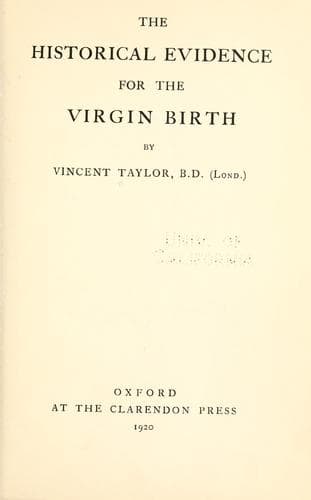
The Historical Evidence for the Virgin BirthTaylor, Vincent
Religion
The Historical Evidence for the Virgin Birth
Taylor, Vincent
Bible. Gospels; Jesus Christ -- Nativity; Virgin birth
47 It may, however, have been accidentally lost. See Moffatt, INT., pp.
238 ff, where the question is discussed.
48 In this connexion it is important to remember that even early
orthographic peculiarities have been accurately preserved. “I have
been much struck by the number of cases in which the old uncials
preserve spellings which can be proved current in the time of the
autographs, but obsolete long before the fourth century. Faithful in
minutiae, they might reasonably be expected to be faithful also in
greater matters” (J. H. Moulton, in an article in the _Classical
Review_, March, 1915, reprinted in _The Christian Religion in the
Study and the Street_, 1919, p. 153). See also the _Prolegomena_,
pp. 42‐56.
49 The italics are ours.
50 Plummer, ICC., St. Lk., pp. xlviii ff.; Harnack, _Luke the
Physician_, p. 104 f.; Moffatt, INT., p. 278 f.; Hawkins, HS., 2nd
Ed., pp. 15 ff.
51 There is a well‐known difficulty of punctuation in verse 35. Ought
we to put a comma, with WH., after κληθήσεται? If we do so, the
subj. is τό γεννώμενον, and ἅγιον is part of the predicate. If we
omit the comma, the whole phrase τὸ γεν. ἅγιον is the subj., and the
pred. is κληθ. υἱὸς θ. (cf. RV. marg.). Most critical editors of the
Greek text omit the comma. It is probable, as the WH. type shows,
that Dr. Hort was influenced by his belief that ἅγιον κληθ. went
together as a quotation or reminiscence of the OT., and, if the
passage comes from St. Luke, this is a strong argument. On the other
hand, it can be argued that if the words are a Greek rendering of an
Aramaic phrase it is improbable, if not impossible, that the
participle should stand alone as the subj. It is not possible, of
course, to settle the question by appealing to manuscript authority,
as the early MSS. were practically devoid of punctuation marks. In
our own case, we are unable to use either of the arguments cited,
since each rests upon the assumption of the Lukan origin of Lk. i.
34 f., which is the very point we are discussing. While then we
follow the WH. text we have to leave the question of punctuation an
open one. If the comma should be omitted we lose the difficulty of
τό γεννώμενον noted on p. 61, and we lose also the argument from its
construction, sketched on p. 64.
Public-domain text, read in full here on John Shaqi.
Reviews
Reviews
No reviews yet
Be the first to share your thoughts on this work.
Elsewhere in the archive
Join the Discussion
Join the discussion
Sign in to leave a comment or review.
Sign InorCreate an account