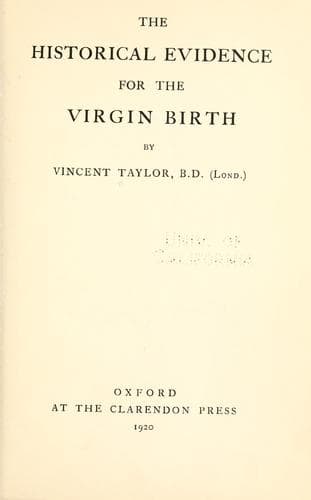
The Historical Evidence for the Virgin BirthTaylor, Vincent
Religion
The Historical Evidence for the Virgin Birth
Taylor, Vincent
Bible. Gospels; Jesus Christ -- Nativity; Virgin birth
As, in the end, we claim that Lk. i. 34 f. comes from the hand of
St. Luke, we may perhaps be permitted to express a personal
preference for the WH. punctuation. St. Luke’s admitted fondness for
OT. phraseology points strongly in this direction, while the theory
of an original Aramaic document gains no increased support, but
rather the contrary, as time goes by. On the one hand, Harnack has
convincingly shown how much the Greek of Lk. i, ii owes to St.
Luke’s craftsmanship (cf. _Luke the Phys._, pp. 102 ff.), and, on
the other hand, the argument from “Semiticisms” becomes less cogent
the more we know of the papyri (cf. Moulton, _Proleg._, pp. 13‐18.
See also Gr. ii. 12‐20). Aramaic oral tradition may underlie cc. i,
ii, but the probability is that the Greek of these chapters owes its
OT. flavour to the more or less deliberate attempt of St. Luke to
create an appropriate archaic atmosphere.
52 The various computations are drawn from the _Concordance to the
Greek Testament_ by Dr. W. F. Moulton and Dr. A. S. Geden. In the
case of St. Luke’s Gospel words occurring in i. 34 f. are omitted.
If these verses are Lukan, this underestimates the Lukan evidence.
It would, however, be begging the question to include these verses
in the present examination. Quotations and doubtful cases (except
where mentioned) are also omitted.
53 But cf. Dalman, _Words of Jesus_, p. 24, quoted by Moulton,
_Proleg._, p. 131.
54 Cf. _The Vocabulary of the Greek Testament_, by Moulton and
Milligan, p. 65 a. See also the note at the foot of p. 131 in the
_Prolegomena_: “This phrase ... occurs in the Semitic atmosphere
alone....”
55 εἶπεν πρός and εἷπεν δέ (see later) are both strongly characteristic
of St. Luke’s style, but εἶπεν with the dative is also very
frequent. Taking the two works together, εἶπεν πρός and εἶπεν with
the dat. are almost equally common (εἶπ. w. dat. having the greater
number of instances). In the G. the proportion of εἶπεν with the
dat. to εἶπεν πρίς is 5 : 4. In Acts it is 4 : 5.
56 The italics are his.
57 Cf. Moulton and Milligan, p. 127 a.
58 Cf. Harnack’s _Luke the Physician_, p. 104; Moulton, _Proleg._, p.
18.
59 So Thayer‐Grimm, p. 117, where it is pointed out that the same idiom
appears in the Latin, in _cognoscere_, Ovid, _Met._ iv. 596.
60 _v._ Moulton and Milligan, op. cit., p. 127 a.
61 So L. T. WH. In both cases WH. give ἐπεί δέ in the margin.
62 There are “261 words which occur in the New Testament only in the
gospel of St. Luke” (Harnack, _Date of Acts_, p. 2). Plummer (ICC.,
St. Lk., lii) speaks of 312 such words, but says that 52 are
doubtful and 11 occur in quotations. Including Acts, according to
Plummer, the number is 750 or (including doubtful cases) 851.
63 P. 59.
Public-domain text, read in full here on John Shaqi.
Reviews
Reviews
No reviews yet
Be the first to share your thoughts on this work.
Elsewhere in the archive
Join the Discussion
Join the discussion
Sign in to leave a comment or review.
Sign InorCreate an account