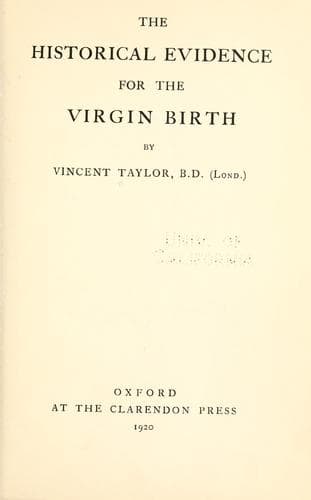
The Historical Evidence for the Virgin BirthTaylor, Vincent
Religion
The Historical Evidence for the Virgin Birth
Taylor, Vincent
Bible. Gospels; Jesus Christ -- Nativity; Virgin birth
Ἰακὼβ δὲ ἐγέννησεν τὸν Ἰωσὴφ τὸν ἄνδρα Μαρίας;
Ἰωσὴφ δὲ ἐγέννησεν τὸν Ἰησοῦν τὸν λεγόμενον Χριστόν.
In addition to the reasons already given, we may also urge the fact that,
with this text posited, we can give the simplest and least involved
account of the origin of (A), (B), (C).
(1) The scribes who have produced (A) substituted the passive (ἐγεννήθη)
for the active (ἐγέννησεν). This caused the second Ἰωσήφ to drop out, its
place being taken by ἐξ ἧς “from whom” (fem.). Ἰησοῦς ὁ λεγ. Χρ. followed
as a grammatical change.
(2) All that the originators of (B) had to do was to substitute ᾧ μνηστ.
π. Μ. for τὸν ἄνδρα Μ., and then, by omitting Ἰωσὴφ δέ, to leave Μ. as the
subject of ἐγέννησεν.
(3) We may explain (C), with Burkitt, as derived from (B). The Syriac
translator was not satisfied with the loose construction of (B). Taking ᾧ
to refer to ἐγέννησεν as well as to μνηστευθεῖσα, he made the connexion
clearer by inserting a second Ἰωσήφ as the subject of the verb. In taking
this last step, he either returned unconsciously to part at least of the
true reading, or had access to good Greek MSS. which we no longer possess.
It is of interest to compare the reading we have suggested as the original
text of Mt. i. 16 with others which have been put forward. In discussing
one of these possibilities, Sanday writes (_Outlines_, p. 200): “If we may
suppose that the original text ran Ἰωσὴφ τὸν ἄνδρα Μαρίας ἣ ἐγέννησεν
Ἰησοῦν τὸν λεγόμενον Χριστόν, that would perhaps account for the two
divergent lines of variants better than any other”. In spite of its
advantages, this text suffers under two disadvantages from which the one
we have preferred is free. (i) Not only is γεννάω used in a different
sense from that which it has in the rest of the Genealogy, but it is _the
very same form of the verb_ which is employed differently. (ii) The
reading is too smooth and clear. Apart from the phrase τὸν ἄνδρα Μ. no
loophole is left for misunderstanding, and so no sufficient starting‐point
is provided for the subsequent textual variants.
Burkitt has instanced the reading we have preferred. In rejecting the view
that the _Syr.‐Sin._ represents the true text, he writes (p. 264): “Had we
such a text as Ἰακ. δὲ ἐγένν. τὸν Ἰωσὴφ τὸν ἄνδρα Μαρίας· Ἰωσὴφ δὲ
ἐγέννησεν κτλ. the case would have been different”. In reference to this
suggestion, however, Burkitt says, (i) the evidence does not point that
way, (ii) in that case the _Syr.‐Sin._ would be further from the original
than that of א B and Tertullian, (iii) _Syr.‐Sin._ and _k_ would “agree in
a common corruption”, and we should have to speak of the “Western” text in
the singular number.
Public-domain text, read in full here on John Shaqi.
Reviews
Reviews
No reviews yet
Be the first to share your thoughts on this work.
Elsewhere in the archive
Join the Discussion
Join the discussion
Sign in to leave a comment or review.
Sign InorCreate an account