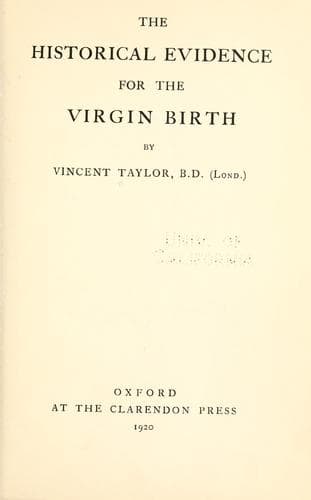
The Historical Evidence for the Virgin BirthTaylor, Vincent
Religion
The Historical Evidence for the Virgin Birth
Taylor, Vincent
Bible. Gospels; Jesus Christ -- Nativity; Virgin birth
The last point raises a large question which it is impossible to consider
here. As regards the second objection, while in some respects (C) would be
further from the original than (A), in other and more important respects
it would be appreciably nearer. In its use of ἐγέννησεν it would be nearer
to the original than any reading we possess. As regards the first
objection, we have frankly to agree that the textual evidence does not
point that way. We cannot point to a shred of MS. evidence to support the
conjectured reading. A generation ago this would have been considered a
fatal objection. But, in view of the freedom with which the text of the
Gospels was handled during the first half of the second century, and which
the textual variants illustrate, this objection can no longer be regarded
as insuperable. So long as we restrict ourselves to the attested readings,
the problem remains insoluble. If, then, we can reach a reasonable
conclusion on other lines, we are free to do so. Doubtless, in default of
attestation, we can describe our results as no more than tentative. But we
have no desire to claim more. As the problem stands at present, the test
to be applied is, What reading, conjectured or attested, furnishes the
best explanation of the facts at our disposal?, it being remembered that
these facts include, not only the textual variants, but also the unique
character of the Genealogy itself. It may be, as we have suggested, that
new discoveries await us. But, unless we have entirely misread the
evidence we already possess, no discovery is to be expected which will
completely transform the textual problem.
In conclusion, we may state certain propositions (apart from the question
of the exact wording of the true text of Mt. i. 16) which have in their
favour a high degree of probability.
(1) The readings which we have called (A) and (B) are independent attempts
to alter the original text in the interests of the Virgin Birth; that is,
they are “doctrinal modifications”.
(2) The reading of the Sinaitic Syriac is not unfavourable to the
doctrine. It should no longer be spoken of as “the eccentric reading”, nor
should we describe the translator as influenced by “heretical tendencies”.
(3) _The original text of Mt. i. 16 implied the Virgin Birth, but it was
stated from the unique point of view reflected in the Genealogy itself._
(4) _The text was liable to misunderstanding, and the history of the
textual variants is the history of that misunderstanding._
CHAPTER VI. THE HISTORICAL QUESTION: ITS LIMITS AND BEARINGS
Our purpose in the final chapter is to co‐ordinate the results we have
reached, and to discuss their bearing upon the historical question of the
Virgin Birth. We have also to determine how far strictly historical
considerations can take us; to ask, that is to say, within what limits the
problem is historical at all. It will be well first to summarize the
conclusions to which we have already come.
Public-domain text, read in full here on John Shaqi.
Reviews
Reviews
No reviews yet
Be the first to share your thoughts on this work.
Elsewhere in the archive
Join the Discussion
Join the discussion
Sign in to leave a comment or review.
Sign InorCreate an account