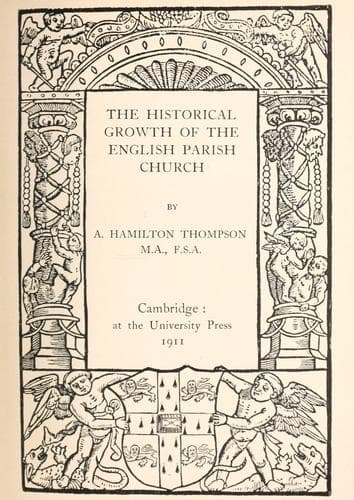
The Historical Growth of the English Parish ChurchThompson, A. Hamilton (Alexander Hamilton)
History
The Historical Growth of the English Parish Church
Thompson, A. Hamilton (Alexander Hamilton)
Church architecture -- England
to the king or the lord from whom the fee was immediately held, the
licence was granted; and, if a church formed part of the property, the
religious corporation was allowed to appropriate it by the grant of a
further licence, the ordination of a vicarage being left to the decree
of the bishop. It need hardly be said that a very large number of
churches remained all through the middle ages in the hands of private
patrons, and that by no means all churches granted to monasteries were
appropriated by them. Of the arrangements for these unappropriated
rectories more will be said later. The connexion of the parish churches
with the monasteries is of great importance, however, for our present
purpose.
§ 8. As so many churches belonged to monasteries, it is constantly
assumed that the monasteries, especially during Norman times, provided
parish churches at their own expense. Thus the splendid series of
churches in south Lincolnshire, on the road from Sutton Bridge to
Spalding, is said, without historical foundation, to have been produced
by rivalry in church-building between Croyland abbey and other
monasteries. It is true that, as at Spalding in 1284, the religious
house would probably contribute a certain amount to the building or
rebuilding of an appropriated church, but that amount would be limited,
and the parishioners would be left to provide the rest according to
their means. When vicarages were ordained, the repair of the chancel,
the rector's peculiar property, was usually left to the monastery as
rector; but we often find that a special stipulation was made by which
part of the repairs even of this portion of the church devolved upon
the vicar, and that sometimes his stipend was so arranged as to free
the monastery of this obligation altogether. A monastery naturally
regarded the fruits of a church as an addition to its own income.
The most that could be expected of it would be that it would employ
a reasonable part of the profits in keeping the fabric in order. If
the monastery owned the manor as well as the advowson, it probably,
and here and there unmistakably, did more for the fabric of the
parish church. But these fabrics were in most cases existing when the
monasteries took seisin of the advowsons of the churches in question.
When appropriation followed, the enrichment of the monastery, not
the enlargement of the building, was the end in view; and the plea
made by the monastery in dealing with the bishop over appropriations,
was invariably one of poverty. When a church, then, was rebuilt or
enlarged, the money came for the most part from parishioners, the
monastery supplying its proportion, not without a view to strict
economy.
Public-domain text, read in full here on John Shaqi.
Reviews
Reviews
No reviews yet
Be the first to share your thoughts on this work.
Join the Discussion
Join the discussion
Sign in to leave a comment or review.
Sign InorCreate an account