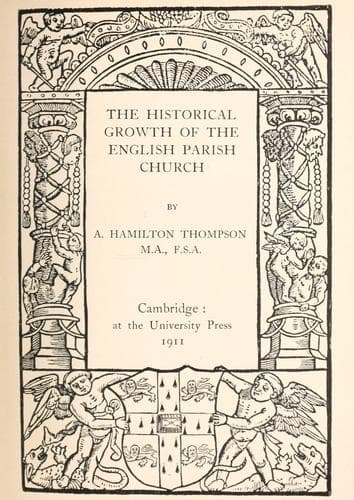
The Historical Growth of the English Parish Church — John Shaqi
The Historical Growth of the English Parish ChurchThompson, A. Hamilton (Alexander Hamilton)
History
The Historical Growth of the English Parish Church
Thompson, A. Hamilton (Alexander Hamilton)
Church architecture -- England
§ 10. Parish churches in England may be divided, for historical
purposes, into four classes. (1) In some monastic churches, as in the
Benedictine priory of Selby and the Augustinian priory of Bridlington,
the parochial altar was in the nave of the church, west of the rood
screen, and was served by a vicar or a curate, who was responsible
for the spiritual welfare of the parish. (2) In collegiate churches
a similar arrangement existed; but in the majority of such cases the
dean or warden of the college was regarded as the parson of the parish,
and had the cure of souls. (3) Of parish churches appropriated to
monasteries, we have spoken already. (4) There remains the very large
number of unappropriated parish churches, in which the rector or parson
was directly responsible for the cure of souls. The duties of the
rector were regarded in the middle ages with considerable latitude.
Nothing was more usual than for a man of good family, or one whose
clerkly talents made him a constant attendant on the king or the great
officers of state, to obtain a number of benefices which provided him
with a necessary income. Such parsons were naturally non-resident: as
often as not, they had not proceeded to full orders. The Patent Rolls
are full of grants of benefices to persons engaged in the work of the
royal chancery or exchequer; while the papal registers in the Vatican
library contain thousands of dispensations by which pluralists were
enabled to hold several benefices at a time, to acquire benefices up
to a stated value, or to defer their ordination to the priesthood.
Popes and bishops alike kept a careful watch on the attempt to obtain
additional benefices without licence; but it is quite obvious that
little discrimination could be exercised, and that dispensations
became matters of form, for which the applicant, backed by a request
from the king or some magnate, made a payment in money. Pluralism was
further increased by the pope's claim to reserve certain benefices on a
vacancy, and provide incumbents to them. This claim, which originally
was intended to prevent patrons from keeping benefices vacant and
appropriating their fruits, led to the enactment of the statute of
provisors in 1351. Papal provisions, though nominally forbidden, were
not stopped by this law, but became subject to regulation.
Public-domain text, read in full here on John Shaqi.
Reviews
Reviews
No reviews yet
Be the first to share your thoughts on this work.
Join the Discussion
Join the discussion
Sign in to leave a comment or review.
Sign InorCreate an account