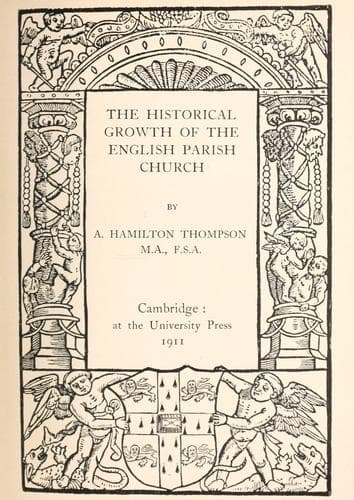
The Historical Growth of the English Parish ChurchThompson, A. Hamilton (Alexander Hamilton)
History
The Historical Growth of the English Parish Church
Thompson, A. Hamilton (Alexander Hamilton)
Church architecture -- England
§ 62. At a later date, Wren built parish churches with an extraordinary
elasticity of style and plan. But the study of Wren's plans is simply
the study of the plans of an individual architect: they are the
outcome of his relation to the fashions of his day, and his unrivalled
capacity for dealing with them. He established firmly the use of a
modified Palladian style in church architecture, which his successors
imitated until nothing further could be done with it. But, when we
look at his churches, we never can forget the architect behind them.
St Martin's-in-the-Fields and St Mary-le-Strand, by Gibbs; St Philip's
at Birmingham, by Archer, fine churches though they are, fall short
of his designs; and we instinctively compare and contrast their plan
and elevation with the models supplied by Wren. In the medieval parish
church, on the other hand, the individual architect had no place;
the whole artistic activity of an age was represented; the builder
was an original artist, and a member of a nation of artists; and the
development of the parish church was the work of a national interest,
not merely confined to one highly specialised profession. When the
Gothic revival came in the early nineteenth century, it was thought
that medieval art was once more re-born. But, when we look to-day
at the scholarly and often extremely beautiful work of artists like
Pugin, Sir Gilbert Scott, Street, Pearson, Butterfield, Bodley, or the
younger Gilbert Scott, we still feel the force of individual design and
style rather than the force of a great collective movement. All these,
like Wren, have added individual contributions to church planning and
decoration; but their art is a by-path of national life, and is merely
the result of a purely individual type of thought.
§ 63. At the same time, to say this is not to belittle post-Reformation
church architecture. It is simply to point out the contrast between
the work of the architect and the work of the medieval mason, between
a sporadic development of art, and a development which was general in
every part of the country.
Public-domain text, read in full here on John Shaqi.
Reviews
Reviews
No reviews yet
Be the first to share your thoughts on this work.
Elsewhere in the archive
Join the Discussion
Join the discussion
Sign in to leave a comment or review.
Sign InorCreate an account