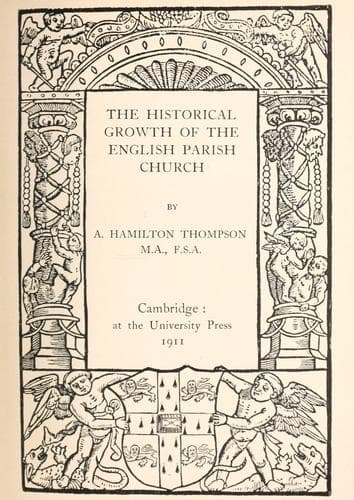
The Historical Growth of the English Parish ChurchThompson, A. Hamilton (Alexander Hamilton)
History
The Historical Growth of the English Parish Church
Thompson, A. Hamilton (Alexander Hamilton)
Church architecture -- England
But, while the work of later generations differs in quality and
spirit from that of the medieval craftsman, while it is necessarily
more sophisticated and less spontaneous than his, no greater mistake
can be made than to drive it out of our churches. The Reformation
and Cromwell have been made responsible for much destruction: yet
no one has destroyed so light-heartedly as the modern restorer, in
his efforts to bring back churches to what is called their 'original
state.' To-day, people are waking up to the value of post-Reformation
masonry and furniture. They realise that when an eighteenth century
church is swept away, and a handsome building, in an eclectic Gothic
style, decked with the best products of modern arts and crafts, rises
in its place, the advantage is questionable. Not merely does much good
furniture inevitably perish, but a link with the past is destroyed.
Eighteenth century pews may not be altogether suited to a fifteenth
century church; but they remind us at any rate that the fabric in
which they stand has a continuous history. The age which produced
them followed its own taste and worked on its own lines, and did not
merely strive after an ideal of harmonious imitation. Not only the
work of recent centuries has been touched, but medieval work has been
altered: screens have been mutilated and removed, old glass has been
destroyed, even whole fabrics have been rebuilt with very slight
regard to their earlier plan. It can never be impressed too strongly
upon the average Englishman that, quite apart from their religious
associations, the parish churches of this country form, as a body,
one of the most remarkable historical monuments which any European
nation possesses. We may regret, perhaps, that past generations have
tampered with them; but for that very reason we should hesitate to
tamper with them ourselves, or to replace incongruous work of the past
by imitative work of our own. We may well use our individual energy
and our new ideas in adding to their number; but our treatment of the
older work, where it positively calls for renewal, should be tender,
conservative, and self-effacing. The excellence of the medieval mason's
work consists largely in his avoidance of self-consciousness, in its
perfectly natural and spontaneous feeling: if we attempt to impose our
individuality upon his work, we are in danger of supplying to future
and, it may be hoped, wiser generations a contrast from which they will
not fail to draw a melancholy profit.
BIBLIOGRAPHICAL NOTE
Books exclusively devoted to the subject of the English parish church
are few in number, and generally are in the form of descriptions of the
churches of special districts, or of monographs on individual churches.
1. Among the older books in which special attention is paid to parish
churches, the following may be mentioned:
BLOXAM, M. H., _Principles of Gothic Ecclesiastical
Architecture_, 11th ed., 2 vols., London, 1882.
Public-domain text, read in full here on John Shaqi.
Reviews
Reviews
No reviews yet
Be the first to share your thoughts on this work.
Elsewhere in the archive
Join the Discussion
Join the discussion
Sign in to leave a comment or review.
Sign InorCreate an account