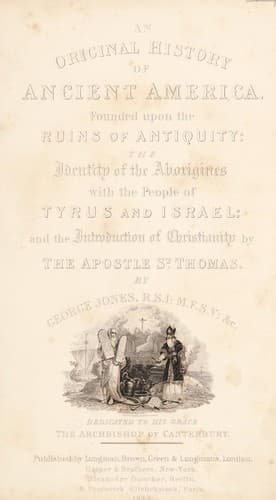
The History of Ancient America, Anterior to the Time of Columbus: Proving the Identity of the Aborigines with the Tyrians and Israelites; and the Introduction of Christianity into the Western Hemisphere By The Apostle St. ThomasJones, George
History
The History of Ancient America, Anterior to the Time of Columbus: Proving the Identity of the Aborigines with the Tyrians and Israelites; and the Introduction of Christianity into the Western Hemisphere By The Apostle St. Thomas
Jones, George
America -- Antiquities; America -- Discovery and exploration -- Phoenician; Indians -- Origin
In the previous Sections of this important chapter, the customs and
analogies of the _living_ have been reviewed and compared,--those now
to be investigated have relation to the _dead_.
In all countries the peculiar customs observed at the interment of the
dead, have a distinct, and a National character:--those customs
proclaim the people of a nation with as much certainty, as the Ruins
of the Parthenon speak of Athens and the Athenians.
At the present day "the _ashes_ of the dead" is a strong, and a poetic
phrase, and used even by Christian writers,--whereas it is strictly
heathen in its application:--"_dust to dust_" is essentially
Christian, and the sentence belongs to, and identifies the modern
European family;--while,--"_ashes_ of the dead,"--indicating thereby,
_fire_ as the consuming quality,--points to India, Rome, and many
ancient Nations as authors of the pyro-ceremony.
Pompey's decapitated body, though thrown upon the shore of Egypt, was
consumed to "ashes" by the humble but honest follower of Cæsar's
Master, that the sepulchral custom of ancient _Italy_ should be
accomplished upon, and by, a Son of Rome. The self-immolation of the
widow upon the funeral pyre of her departed husband, points to the
nation following that inhuman custom to be Hindoostan;--while the
embalmed Mummies with their Sarcophagi, direct the antiquarian mind to
Egypt, with as much certainty, as her "starry-pointing Pyramids," or
her Sphinx-guarded Temples. Upon this accredited conclusion of the
identity of nations, from the manner of disposing of their dead, will
be claimed authority to establish a strong argument and analogy in
support of the present subject,--and founded upon the _fac-simile_
resemblance between the ancient Mummies of the Canary Islands, and
those in Mexican America.
The general reader may not be aware that Mummies have been found in
any other nation than Egypt;--they have, however, been discovered (but
without the Sarcophagi) at _Arico_, in the Island of Teneriffe, and at
_Arica_ in Peru,--a similitude is discernible even in the local name
given to the districts where the Mummy-pits are found. An analogy is
at once perceptible in analyzing the ancient word _Guanches_ (the
Aborigines of Teneriffe),--it is derived from _Guan_,--_i. e._
Man,--consequently in his natural and uncontrolled state,--therefore
Freemen,--this fact is sanctioned _by their escape from thraldom_ or
SLAVERY, when they first arrived on the Island, as will be shewn in
the Second Book of this Volume. Again, in Ancient America, the places
where Mummies are found are called _Guacas_,--_i. e._ the abode of Man
in his decayed state. The Reader will instantly perceive that in the
construction of the word, as used in both localities, there is a
direct similitude. The first land also rediscovered by Columbus in
the Western Hemisphere, was called by the natives--_Guanahani_,--the
Genoese named it St. Salvador.
Public-domain text, read in full here on John Shaqi.
Reviews
Reviews
No reviews yet
Be the first to share your thoughts on this work.
Elsewhere in the archive
Join the Discussion
Join the discussion
Sign in to leave a comment or review.
Sign InorCreate an account