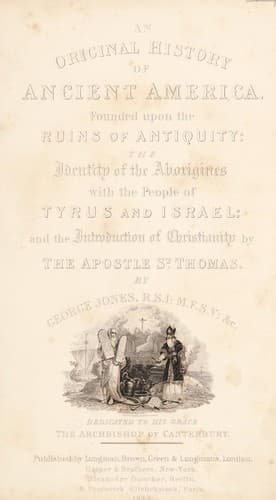
The History of Ancient America, Anterior to the Time of Columbus: Proving the Identity of the Aborigines with the Tyrians and Israelites; and the Introduction of Christianity into the Western Hemisphere By The Apostle St. ThomasJones, George
History
The History of Ancient America, Anterior to the Time of Columbus: Proving the Identity of the Aborigines with the Tyrians and Israelites; and the Introduction of Christianity into the Western Hemisphere By The Apostle St. Thomas
Jones, George
America -- Antiquities; America -- Discovery and exploration -- Phoenician; Indians -- Origin
The word "Teneriffe," in the original language of the ancient
inhabitants,--the Guanches,--signifies--White-Mountain,--(_Thanar_--
mountain,--and _Iffe_--white),--from the celebrated Peak being (from
its altitude) always covered with snow.
In the singular burial-cavern of the Capuchin Friars near Palermo,
there are over 2000 dead bodies,--they have erroneously been called
"Mummies;"--for the bodies are not in any manner embalmed, but dried
by a slow fire, (or furnace-oven) and then arranged in groups around
the subterranean galleries.
The word "mummy" was originally applied to a drug so called; and it
was probably used by the Egyptians as one of their ingredients in
embalming--or preserving--the dead. The Bard of Avon evidently so
understood it,--viz., that it was a drug possessing a _preserving_
quality. Othello's description of his "first gift" to Desdemona will
explain.--
"That handkerchief did an Egyptian
To my mother give.
* * * * *
The worms were hallow'd that did breed the silk:
And it was _dyed in mummy_ which the skilful
Conserved of maiden's hearts."
It may appear strange, at the first glance, that there should be any
connexion between the Mummies of Teneriffe and those of Peru, towards
establishing that the Mexican Aborigines were originally
Tyrians:--but there is a connexion, and as certain, as that a chain of
three links owes its utility to the connecting power of the central
one. Teneriffe forms that central link between Tyrus and the Western
Continent.
The natural and apparent question then is,--Were the Guanches (ancient
Canarians) originally from the Tyrian family?--this we distinctly
answer in the affirmative.
Mr. Pettigrew, in his valuable "History of Egyptian Mummies," has the
following remark upon those discovered at Teneriffe.
"That the inhabitants of the Canary Islands should have adopted _a
practice of embalming in some measure similar to that of the Egyptian
is rather singular_,--seeing they were separated from each other by
_the entire breadth of Northern Africa_." [p. 237.]
Now the above author assumes, as a necessity,--that the ancient
Guanches (Canarians) must have emigrated by _land_,--otherwise the
sentence "entire breadth of Northern Africa" is uselessly brought
forward to express the barrier between the Islands and Egypt. The
emigration by land cannot be sustained, but is absolutely rejected,
from the fact, that the Guanches must have had navigable means to have
reached the chief Islands even _after_ they had arrived upon the
Shores of the Continent,--which are nearly 150 miles from Teneriffe.
This fact then points to a nation having acquaintance with Egypt, and
the means of Navigation,--and also of one "advanced in civilization,"
for such were the now extinct nation of the Guanches, as related by
Spanish historians. Truth seems at once to point to the Tyrians as the
Aborigines of those Islands.
Public-domain text, read in full here on John Shaqi.
Reviews
Reviews
No reviews yet
Be the first to share your thoughts on this work.
Elsewhere in the archive
Join the Discussion
Join the discussion
Sign in to leave a comment or review.
Sign InorCreate an account