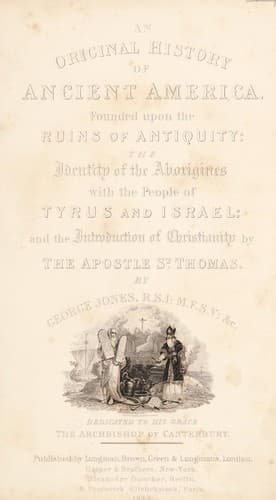
The History of Ancient America, Anterior to the Time of Columbus: Proving the Identity of the Aborigines with the Tyrians and Israelites; and the Introduction of Christianity into the Western Hemisphere By The Apostle St. ThomasJones, George
History
The History of Ancient America, Anterior to the Time of Columbus: Proving the Identity of the Aborigines with the Tyrians and Israelites; and the Introduction of Christianity into the Western Hemisphere By The Apostle St. Thomas
Jones, George
America -- Antiquities; America -- Discovery and exploration -- Phoenician; Indians -- Origin
The manner described above, may have been the custom throughout all
Mexican America;--that they are only discovered at Arica in _Peru_,
may arise from natural causes,--viz., at Arica the rain never falls
(as in Egypt) and the soil is calcareous,--and the dryness of the
atmosphere, with the saline qualities of the earth, produce natural
embalming; thus preserving the body for ages from decomposition,--while
in other portions of the Continent, from the moisture, and the absence
of the preserving qualities, the bodies would gradually decay, and
return and mingle with the undistinguishing dust of centuries. Many
analogies are found to the Tyrians, in the details and decorations of
the Peruvian Mummies,--both of the rich and the poor. Those of the
poor are invariably found resting upon beds of _broken fish-shells_;--
these beds are supposed to be placed there for "religious motives."
May not the purple murex (_i. e._ dye shellfish) of Tyrus (as on the
Altar of Copan) be here alluded to by this religious custom? In the
same Mummy-pits (and they extend over a mile) are found various
_models of _boats_, _lines_, _and fish-hooks_; these are buried with
the Mummies, and they are evident witnesses of the occupation,--or the
"religious motives" of the departed. Is not Tyrus here also?--her
fisheries were her National emblems. And that this custom (whereby the
means of sustenance were obtained) was practised in South America by
the Aborigines, is distinctly stated by Dr. Robertson, upon the
authority of Berrere. The statement, also, shews that the distinction
between those of the North and South, or Mexican America is
apparent,--those of the former depended upon hunting for their
sustenance,--those of the latter,--or the Tyrian descendants,--as did
their ancestors, upon their fisheries. Robertson says--"In this part
of the globe (_i. e._ South America) hunting seems _not_ to have been
the first employment of men, or the first effort of their invention
and labour to obtain food. They were _fishers_ before they became
hunters." [Vol. v., Book iv., p. 318.]
The _boat-model_ is directly emblematical of a Religious custom of
Tyrus,--copied from the Egyptian,--viz., the belief that the _Soul_
had to pass through various stages and translations, before it reached
its final destination or happiness. To accomplish this, the _body_ was
to pass over a River,--in a sacred-barge or boat:--the the helmsman
was called by the Egyptians in their own language,--_Charon_. The
Classic reader will instantly trace the mythological fable of Greece,
concerning the Ferryman of the River Styx,--probably introduced into
Grecian Thebes by the Tyrian Cadmus.
Public-domain text, read in full here on John Shaqi.
Reviews
Reviews
No reviews yet
Be the first to share your thoughts on this work.
Elsewhere in the archive
Join the Discussion
Join the discussion
Sign in to leave a comment or review.
Sign InorCreate an account