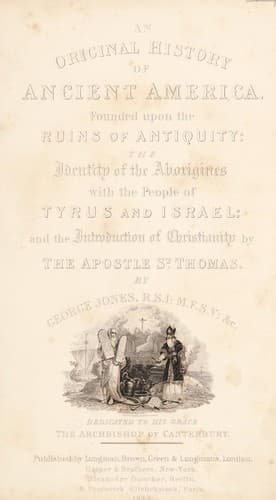
The History of Ancient America, Anterior to the Time of Columbus: Proving the Identity of the Aborigines with the Tyrians and Israelites; and the Introduction of Christianity into the Western Hemisphere By The Apostle St. ThomasJones, George
History
The History of Ancient America, Anterior to the Time of Columbus: Proving the Identity of the Aborigines with the Tyrians and Israelites; and the Introduction of Christianity into the Western Hemisphere By The Apostle St. Thomas
Jones, George
America -- Antiquities; America -- Discovery and exploration -- Phoenician; Indians -- Origin
Mr. Pettigrew probably forgot that Herodotus has recorded the
celebrated Egypto-Tyrian expedition around the Continent of Africa,
and which occurred 609--606 years before Christ. It is apparent that
the _Fortunatæ Insulæ_,--as the Canary Islands were called by the
Ancients,--were discovered during the three years voyage related by
the Greek historian, for they were known to the Tyrians centuries
before the Christian Æra. This celebrated expedition, and the proofs
of its being accomplished, will be investigated and established in the
pages devoted to the History of Tyrus.
After the direful event which drove the Tyrians for ever from the
Mediterranean (which will be elucidated hereafter), we believe that
their first resting-place was among the Canary Islands,--and as the
Peak of Teneriffe arose as a welcome beacon,--that Island became to
them the chief place of temporary residence after their fortunate
escape. It appears almost evident that the group was then named by the
Tyrians,--for as _the Fortunate Isles_ they are known in ancient
geography. The name seems to allude to some "foregone conclusion," a
peculiarly happy circumstance (_i. e._ escape from foe or wreck) being
connected with the naming.
That the Aborigines of these Islands, and those of Ancient America
were the same, will be admitted from the Mummies discovered in the two
Countries. They are identical with each other, and they are not
Egyptian,--for they lack the stone Sarcophagi, the hieroglyphics and
the mummy Cloths. The mummies of Peru and Teneriffe are bound in skins
of animals,--(a custom no where else _found_, although it is
_recorded_ of the Scythians)--those of the former in the skin of the
lama,--those of the latter in the goat-skin, an animal with which the
Island abounded, and with the skins of which the original inhabitants
clothed themselves. The Mummies of both Countries are also, bound
within the skins by leather thongs and straps, made from the hides of
the respective animals. Such facts cannot be accidental,--they must be
identical.
Public-domain text, read in full here on John Shaqi.
Reviews
Reviews
No reviews yet
Be the first to share your thoughts on this work.
Elsewhere in the archive
Join the Discussion
Join the discussion
Sign in to leave a comment or review.
Sign InorCreate an account