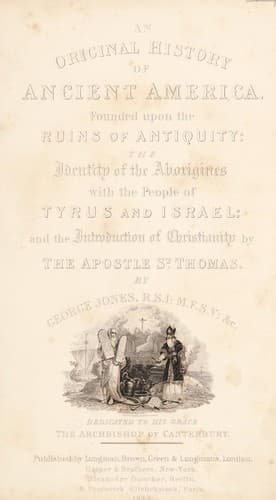
The History of Ancient America, Anterior to the Time of Columbus: Proving the Identity of the Aborigines with the Tyrians and Israelites; and the Introduction of Christianity into the Western Hemisphere By The Apostle St. ThomasJones, George
History
The History of Ancient America, Anterior to the Time of Columbus: Proving the Identity of the Aborigines with the Tyrians and Israelites; and the Introduction of Christianity into the Western Hemisphere By The Apostle St. Thomas
Jones, George
America -- Antiquities; America -- Discovery and exploration -- Phoenician; Indians -- Origin
Of the Sons of Ham:--_Cush_, the eldest, was the father of Nimrod, the
founder of the Babylonian and Assyrian families: the second son,
_Mizraim_, was the founder of the Egyptian empire,--thence the ancient
name of Mizraim being applied to that country.--_Phut_, the third son,
_apparently_ died without issue,--at least there is no scriptural
record of his descendants; but, as this would be very improbable in
that early date, immediately following the Deluge,--we will venture
the suggestion, whether the third Son was not the founder of the great
African family--known as Negroes; for this is the only race not
defined (apparently) by Moses,--and Phut is the only child of the
"accursed" branch of Noah's "house," whose descendants are not
mentioned. _Canaan_--the fourth and youngest son--was the founder of
the Canaanites. Canaan had eleven children, all of whom (except one)
established Nations known under one general name--Canaanites:--who,
as a people were subsequently conquered, and their lands possessed by
Moses, Joshua, and the Israelites. The _first Child of Canaan_,
however, was not included with his brethren in founding the
Canaanitish family.
"And Canaan begat SIDON, his firstborn." [Genesis x. 15.]
From that "firstborn" of Canaan sprung the great Phœnician
family:--for upon the authority of Justin, an earthquake compelled a
_portion_ of the family of Canaan to leave the country they had first
settled in, and they took up their residence upon the border of the
Assyrian Lake:--but which they afterwards vacated, and journeyed to
the Sea-coast, [2178 B.C.] where the leader of that portion,--viz.,
_Sidon_,--built a city bearing his name, and he thus became the
founder of the great maritime Nations of the Mediterranean; and being
divided from their brethren, the Sidonians became a separate and
independent people.
1689 B.C.] In the deathbed blessing of JACOB upon Zebulun, the country
of Sidon is mentioned. [Genesis xlix. 13.]
"Zebulun shall dwell at the haven of the sea; and he shall be for an
haven of ships: and his border shall be unto _Sidon_."
1451 B.C.] MOSES wrote of them as a Nation in more than one
instance.--
"And the border of the Canaanites was from SIDON, as thou comest to
Gerar unto Gaza." [Genesis x. 19.]
"--* * * from the river of Arnon unto Mount Hermon, (which Hermon the
_Sidonians_ call Sirion; and the Amorites [Canaanites] call it
Shenir)." [Deut. iii. 8,9.]
In the last quotation the Sidonians are distinctly stated to be a
separate nation from the other branches of the Canaanites.
1444 B. C.] JOSHUA, also, defines them to be so, and a powerful one.
"And the LORD delivered them [the Canaanites] into the hand of Israel,
who smote them, and chased them _unto great_ SIDON," &c. [Joshua xi.
8.]
Public-domain text, read in full here on John Shaqi.
Reviews
Reviews
No reviews yet
Be the first to share your thoughts on this work.
Elsewhere in the archive
Join the Discussion
Join the discussion
Sign in to leave a comment or review.
Sign InorCreate an account