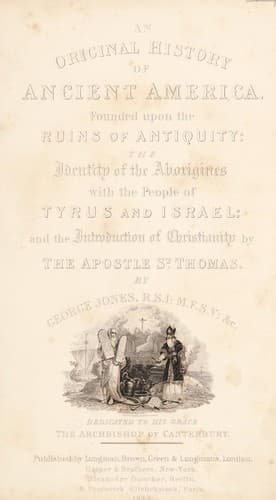
The History of Ancient America, Anterior to the Time of Columbus: Proving the Identity of the Aborigines with the Tyrians and Israelites; and the Introduction of Christianity into the Western Hemisphere By The Apostle St. ThomasJones, George
History
The History of Ancient America, Anterior to the Time of Columbus: Proving the Identity of the Aborigines with the Tyrians and Israelites; and the Introduction of Christianity into the Western Hemisphere By The Apostle St. Thomas
Jones, George
America -- Antiquities; America -- Discovery and exploration -- Phoenician; Indians -- Origin
The early character of National Independence enjoyed by the Sidonians,
and the primitive character of justice among them, may be gathered
from the description of the people of Laish, who are compared to the
Sidonians; and the military prowess of the latter people is also
expressed.
1406 B. C.] "Then the five men departed, and came to Laish, and saw
the people that were therein, how they dwelt _careless, after the
manner of the Sidonians, quiet and secure_; and there _was no
magistrate in the land_,[11] that might put _them_ to shame for any
thing;--[_i. e._ for crimes]--and they were far from the Sidonians,
and had no business with any man." "And there was no deliverer,--_because_
it [Laish] was far from Sidon." [Judges xviii. 7, 28.]
[11] The increase of crime in any Nation is instantly ascertained,
by finding the ratio increase of Lawyers,--and the purity of a
People by their absence,--as at Laish,--of course having regard to
the relative increase of population. The same argument will
obtain, in reference to the increase of physical disease, by
observing the ratio increase of the members of the Medical
profession.--G. J.
In the course of time there were six Kingdoms or Nations of
Phœnicia,--viz., Sidon, Tyrus, Aradnus, Berytus, Byblos, and
Carthage. The inhabitants of the kingdoms in Asia bore one general
name--Phœnicians,--though each had its own name from its
derivative,--as Sidonians, Tyrians, &c. The great nation in Africa,
was not included in the general appellation, but from its Republican
character, possessed its own,--viz., Carthaginians.
HISTORY OF TYRUS.
ITS RISE AND FALL, AND THE MIGRATION OF THE TYRIANS TO THE WESTERN
HEMISPHERE.
CHAPTER II.
(1600-1046 B.C.)
THE FOUNDING OF TYRUS--EARLY NAVIGATION OF THE TYRIANS--FOUNDING
OF THE MONARCHY--THE FIRST KING OF TYRUS, &c.
The Nation of Sidon having increased in power and population, sent one
of the Cadmii with a Colony to found _Pæle Tyr_: this was on the
_Continent_, or main land of the Phœnician coast,--23 miles from
Sidon, and 80 from ancient Jebus (_i. e._ Jerusalem). The Mother-land
at another period sent a second Colony to aid the previous one, and
from which blended circumstance, it is found in the Bible that Tyrus
is called "The Daughter of Sidon." The year in which the first Colony
was sent, is not defined, but it must have been many years before the
Conquest of the Canaanites by JOSHUA;--for not only were there in
existence at that time the "great Sidon,"--but, in dividing the
subdued lands among the Tribes, that of Asher received certain
portions on the sea-coast of Phœnicia, and it is distinctly stated
that Tyrus at that period was a metropolis and fortified.
"And Hebron, and Rehob, and Hammon, and Kanah even unto great Sidon;
and then the coast turneth to Ramah, and to _the strong City Tyre_,"
&c. [Joshua xix. 28-29.]
Public-domain text, read in full here on John Shaqi.
Reviews
Reviews
No reviews yet
Be the first to share your thoughts on this work.
Elsewhere in the archive
Join the Discussion
Join the discussion
Sign in to leave a comment or review.
Sign InorCreate an account