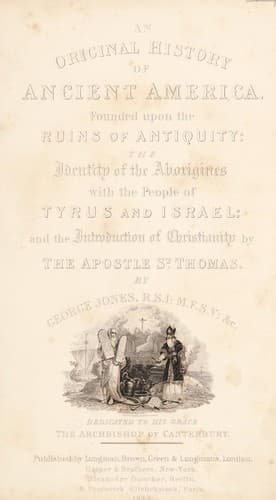
The History of Ancient America, Anterior to the Time of Columbus: Proving the Identity of the Aborigines with the Tyrians and Israelites; and the Introduction of Christianity into the Western Hemisphere By The Apostle St. ThomasJones, George
History
The History of Ancient America, Anterior to the Time of Columbus: Proving the Identity of the Aborigines with the Tyrians and Israelites; and the Introduction of Christianity into the Western Hemisphere By The Apostle St. Thomas
Jones, George
America -- Antiquities; America -- Discovery and exploration -- Phoenician; Indians -- Origin
It is, therefore, evident that Tyrus was a "strong city" anterior to
1444 B.C., which was the time of JOSHUA, and the conquest of the "land
of promise;"--we have, therefore, and in reference to an event
previous to Joshua, placed the foundation of Tyrus as early as 1600
years B.C. Some authors have remarked that HOMER has not mentioned
Tyrus, and as a consequence, that that City was not in existence at
the period of the Siege of Troy. Homer mentions both Mother and
"Daughter" under one name; viz., Sidonians: it was a term applied by
the ancients to both Nations, and to every thing elegant in
Art,--until the Tyrians by their superior skill won their own, and a
distinctive appellation. Nor can Homer be charged with ignorance in
joining the two names;--he followed what appears from his own language
to have been a received custom. This is also proved by Solomon's
message to a subsequent King of _Tyrus_,--and the Tyrians in their
early days were flattered by being called Sidonians.
"For thou knowest that there is not among us [_i. e._ Israel] any that
can skill to hew timber like unto the _Sidonians_." [1 Kings v. 6.]
Then to assert that Tyrus did not exist at, or before the Fall of
Troy, because the Epic Poet does not mention it,--or that it is not to
be found recorded as a city, is to proclaim that which is not
sanctioned by the consentient voice of acknowledged history. We will
briefly review this point.
The Trojan war, consequent upon the rape of the Spartan Queen,
commenced in the year 1194 B.C. Now in the previous page it is proved,
that Tyrus was a "strong City" 250 years before the Siege of Troy, for
Joshua speaks of it as one of the boundaries for the Tribe of Asher,
and this event was 1444 B.C., and that upon the authority of
Holy-Writ.
Again.--Had such sceptics in the antiquity of Tyrus, given a moment's
consideration to the Grecian Fleet, employed to convey Agamemnon and
his troops to Troy, they would have found that the Knowledge of
Navigation was first introduced at Sidon, and was, as a practical
science,--established by the Tyrians,--and from them the Greeks
derived their nautical skill and knowledge.
Homer intended both Nations in the one term,--Sidonians:--but,
Euripides is more defined, for his subject demanded it;--and as it has
reference to this History, as being the first recorded event after the
founding of Tyrus, it will be mentioned more in detail.
1493 B.C.] Forty-nine years before the period in which Joshua divided
the lands of Canaan, a Tyrian Chief (_i. e._ a Cadmus) left Tyrus and
Sidon (apparently with a colony) and founded Thebes in Greece. He is
known in classic history as Cadmus, and has the reputation of
introducing into his new territory of Thebes, the ciphers of his
country, and from which were formed the letters of the ancient Grecian
alphabet,--the language in which Homer subsequently depicted the deeds
of Greeks and Trojans.
Public-domain text, read in full here on John Shaqi.
Reviews
Reviews
No reviews yet
Be the first to share your thoughts on this work.
Elsewhere in the archive
Join the Discussion
Join the discussion
Sign in to leave a comment or review.
Sign InorCreate an account