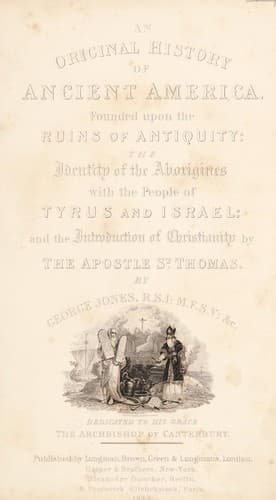
The History of Ancient America, Anterior to the Time of Columbus: Proving the Identity of the Aborigines with the Tyrians and Israelites; and the Introduction of Christianity into the Western Hemisphere By The Apostle St. ThomasJones, George
History
The History of Ancient America, Anterior to the Time of Columbus: Proving the Identity of the Aborigines with the Tyrians and Israelites; and the Introduction of Christianity into the Western Hemisphere By The Apostle St. Thomas
Jones, George
America -- Antiquities; America -- Discovery and exploration -- Phoenician; Indians -- Origin
For about five centuries and a half, Tyrus was governed by Chiefs of
the People,--each succeeding Cadmus having the civil, military, and
naval power,--not granted to him as to a Dictator, but aided by a
Council, somewhat similar to the Judge and Sanhedrim of Israel. The
same causes may have led the People of Tyrus to demand a King as the
Israelites, and they may have used the same argument. Not only that,
but the Tyrians may have received the idea itself of a Monarchy from
their neighbours of Israel, who obtained it only _thirty-nine years_
before the Tyrians. There seems to be such a singular connexion in
regard to the periods of the commencement of the first Monarchies of
Israel and Tyrus; for, by tracing the causes of the former, a
conclusion may be arrived at for the latter. The following quotations
will be found in the first Book of Samuel [ch. viii.]:
"And it came to pass that when Samuel was old, that he made his Sons
Judges over Israel." * * * "And his Sons [Joel and Abiah] walked not
in his ways, but turned aside after _lucre_, and took _bribes_ and
_perverted judgment_. Then all the elders of Israel gathered
themselves together and came to Samuel unto Ramah; and said unto him,
Behold thou art old, and thy sons walk not in thy ways:--now _make us
a_ KING _to judge us like all the nations_."
SAMUEL'S celebrated remonstrance against the institution of an
unlimited Monarchy was useless.
"Nevertheless the people refused to obey the voice of Samuel; and they
said, Nay!--but we _will_ have a King over us:--_that we also may be
like all the Nations_; and that our King may judge us, and go out
before us, and fight our battles." Saul was consequently anointed the
first King of Israel,--this was in 1095 B.C. Such an event could not
pass unnoticed by the Tyrians. Israel had passed from the flowing
robes of a chief Judge, to the gorgeous Mantle and Crown of
Sovereignty. The Tyrians had already received some of the customs of
the Hebrews,--that especially of Circumcision,--and they may have
felt that Monarchy was becoming, in the scale of Nations, as a test of
a People's power,--and it would naturally lead them to exclaim, "Let
_us_ be governed like all the nations." Whatever the arguments of the
Tyrians for a King, certain it is, that in a few years (39) after the
election of the first Monarch in Israel, the Tyrians threw off the
Cadmean Government, and elected their first King in the person [1056
B. C.] of ABIBAL,--who, according to Menander of Ephesus, and Dius of
Phœnicia, commenced his reign in the year 1056 B. C. This record is
sanctioned by the Jewish historian Josephus, who is supported by
Theophilus Antiochenus.
Public-domain text, read in full here on John Shaqi.
Reviews
Reviews
No reviews yet
Be the first to share your thoughts on this work.
Elsewhere in the archive
Join the Discussion
Join the discussion
Sign in to leave a comment or review.
Sign InorCreate an account