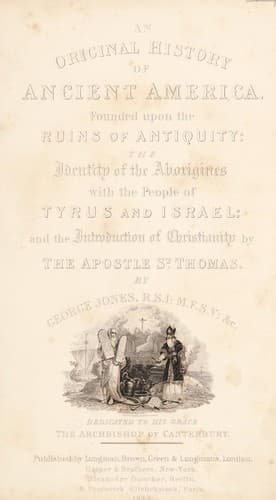
The History of Ancient America, Anterior to the Time of Columbus: Proving the Identity of the Aborigines with the Tyrians and Israelites; and the Introduction of Christianity into the Western Hemisphere By The Apostle St. ThomasJones, George
History
The History of Ancient America, Anterior to the Time of Columbus: Proving the Identity of the Aborigines with the Tyrians and Israelites; and the Introduction of Christianity into the Western Hemisphere By The Apostle St. Thomas
Jones, George
America -- Antiquities; America -- Discovery and exploration -- Phoenician; Indians -- Origin
An additional impulse would naturally be given to the Tyrians in
regard to a Monarchy, from the fact, that in this very year the first
King of Israel (being defeated in the battle of Gilboa) committed
suicide, and DAVID (who was already in renown) was chosen to the
Sovereignty of the house of Judah: not over all Israel,--that followed
eight years after. Therefore the _second_ Hebrew King, and the _first_
Tyrian Monarch, ascended their respective thrones in the _same
year_--(1056 B. C.)--and between whom there commenced, and continued,
a lasting friendship. It would therefore seem that the ancient victory
obtained by the Tyrians, in driving from the sea-coast the Tribe of
Asher, had been acknowledged to the victors, without any resentment
from the united Tribes of Israel. As the conflict on the part of the
Tyrians was founded in justice against encroachment, the descendants
of Abraham, feeling keenly the bondage they experienced in Egypt,
could estimate and appreciate a victory, gained upon the very ground
of argument which they themselves had resolved to resent,--conquer or
die!
Abibal reigned apparently with satisfaction to his subjects, as he did
not die a violent death:--and the hereditary succession to the throne
was established by the People in the reception of his Son,--Hiram,--who
became the most celebrated of the Tyrian Monarchs.
Abibal reigned ten years and died in the year 1046 B. C.,--and from
Scripture seems to have borne the surname of Huram (_i. e._ Hiram),
which has led some authors to style his son and successor, Hiram the
Second. The following, however, is an extract from the letter written
by the Son of Abibal to Solomon, after the death of the first King of
Tyrus, wherein the father's name is distinctly stated to be Huram. The
letter has reference to the Temple.
"And now I have sent a cunning man, endued with understanding, of
_Huram_ my father's."
The Phœnician writer, Dius, and others, style the first King,
_Abibal_, without any surname:--if it had been borne, it is likely
that it would have been mentioned. It appears, therefore, evident that
the National name of the first King was Abibal only,--Huram (_i. e._
Hiram) was perhaps the family name, and assumed by the Second Monarch
in remembrance of that fact, and in affection to his Parent.
CHAPTER III.
HIRAM THE GREAT.
(1046--990 B. C.)
BUILDING OF DAVID'S PALACE--THE FRIENDSHIP BETWEEN TYRUS AND
ISRAEL--BUILDING OF SOLOMON'S TEMPLE BY HIRAM--THE COMMERCE AND
FLEETS OF TYRUS--THE CAUSES OF HER WEALTH AND POWER--POLICY WITH
FOREIGN COUNTRIES, &c.--DEATH OF HIRAM--HIS CHARACTER.
Public-domain text, read in full here on John Shaqi.
Reviews
Reviews
No reviews yet
Be the first to share your thoughts on this work.
Elsewhere in the archive
Join the Discussion
Join the discussion
Sign in to leave a comment or review.
Sign InorCreate an account