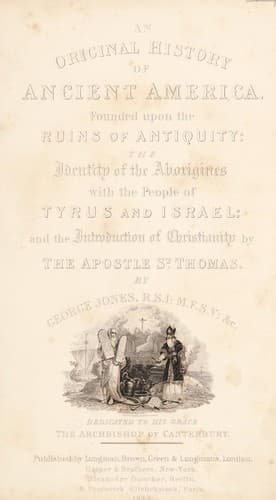
The History of Ancient America, Anterior to the Time of Columbus: Proving the Identity of the Aborigines with the Tyrians and Israelites; and the Introduction of Christianity into the Western Hemisphere By The Apostle St. ThomasJones, George
History
The History of Ancient America, Anterior to the Time of Columbus: Proving the Identity of the Aborigines with the Tyrians and Israelites; and the Introduction of Christianity into the Western Hemisphere By The Apostle St. Thomas
Jones, George
America -- Antiquities; America -- Discovery and exploration -- Phoenician; Indians -- Origin
The above artist,--the Tyrian Phidias,--whose genius seems to have
been universal, had been named in compliment after the reigning
monarch of his country,--viz., Hiram,--and the Tyrian love of the Arts
may be gathered from the fact that the "King's namesake was the
artist-ambassador from Hiram to the King of Israel. This special Envoy
might, also, have been selected in compliment to Solomon, for the
artist's widowed mother was an Israelite, of the Tribe of Dan [the 1st
Book of Kings states of the tribe of Naphtali], his father was a
Tyrian, and also, doubtless renowned for works of art,--as it was the
Tyrian, as well as the Egyptian custom, for the son to be of the same
profession or trade as the father; thence the numerous pilots and
mariners of Tyrus. The same custom prevails at this day in the ancient
institutions of China, upon the principle that as a king's son shall
be king, so shall every son be as the father.
For what the ambassadorial artist accomplished the reader is referred
to the Books of Kings and Chronicles,--a higher compliment was never
paid to the Arts than by the appointment of an Architect and Sculptor
to be a monarch's ambassador to a foreign King, and his representative
at the building of the chief Temple of a powerful potentate; and as if
to give peculiar character to the Tyrian Envoy's reception at
Jerusalem, SOLOMON deputed a delegation to proceed to Tyrus, for the
purpose of escorting him to Israel, that the chief artist of The
Temple should have those honours conferred upon him, which were alike
demanded by the solemnity of the occasion, the amity of the King of
Tyrus, and the intellectual character of the artist-envoy.
"And Solomon _sent and fetched_ Hiram [the artist] out of Tyre.
[1 Kings vii. 13.]
Hiram the King not only, through his artists, built The Temple of
Jerusalem for SOLOMON, but also his "house [cedar palace] of the
forest of Lebanon," and a palace for his Egyptian wife, the daughter
of Pharaoh, king of Egypt. For these services Hiram received the
promised gift of SOLOMON,--viz., 20,000 bushels of flour ("beaten
wheat"), 20,000 bushels of wheat, and of wine and oil 150,000 gallons
each,--for an "Epha" or "bath of wine," is a fraction more than
seven-and-a-half gallons. In addition to the above, which may be
received as for the Temple only, there was also, a Treaty of peace and
amity drawn up between the two neighbouring kings,--to the effect that
Hiram should receive an _annual_ payment,--that might have been for
the two Palaces erected after The Temple.
"And Solomon gave Hiram twenty thousand measures of wheat for food to
his household, and twenty measures ("baths") of pure oil: thus gave
Solomon to Hiram _year by year_. And there was _peace_ between Hiram
and Solomon:--_and they two made a_ LEAGUE _together_:" [1 Kings v.
11, 12.]
Public-domain text, read in full here on John Shaqi.
Reviews
Reviews
No reviews yet
Be the first to share your thoughts on this work.
Elsewhere in the archive
Join the Discussion
Join the discussion
Sign in to leave a comment or review.
Sign InorCreate an account