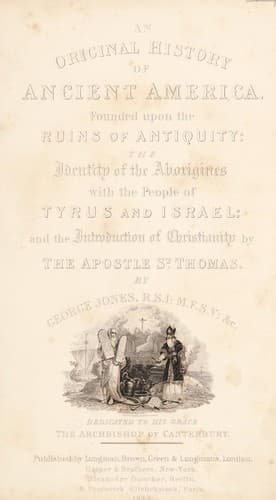
The History of Ancient America, Anterior to the Time of Columbus: Proving the Identity of the Aborigines with the Tyrians and Israelites; and the Introduction of Christianity into the Western Hemisphere By The Apostle St. ThomasJones, George
History
The History of Ancient America, Anterior to the Time of Columbus: Proving the Identity of the Aborigines with the Tyrians and Israelites; and the Introduction of Christianity into the Western Hemisphere By The Apostle St. Thomas
Jones, George
America -- Antiquities; America -- Discovery and exploration -- Phoenician; Indians -- Origin
The last line of the previous quotation,--viz., and Hiram and Solomon
"made a _league_ together," may have reference to a fact mentioned by
Tatian, who followed the records of three Phœnician historians,--viz.,
that Hiram gave his _daughter_ [we think his _sister_] in marriage to
King SOLOMON, and that it was through her influence that he was
seduced to worship Astartē, the Tyrian Goddess. This record by Tatian
is apparently supported by Scripture itself.
"But King Solomon loved many strange women together [besides] with the
daughter of Pharaoh [Egypt], women of the Moabites, Ammonites,
Edomites, and _Sidonians_" [Tyrians.] * * * "And it came to pass when
Solomon was old that his wives turned away his heart after _other
gods_." * * * "_For Solomon went after Ashtoreth_ [Astartē] _the
goddess of the Sidonians_" [Tyrians.] "And likewise did he for all his
_strange wives_, which burnt incense and _sacrificed unto their
gods_." [1 Kings xi.]
The King of Israel having broken his nation's law by marrying out of
his kingdom,--as by his union with a daughter of Egypt,--it would
naturally appear to him to be no increase of the misdemeanor by
intermarrying with a Tyrian Princess; and believing that this event
must have been some years subsequent to the building of The Temple, we
have, therefore, hazarded the date at 1000 B. C.
The wealth expended by SOLOMON in the building The Temple,--his
Palaces,--and that attending his household, had greatly impoverished
the national treasury, and led to excessive taxation; and this was the
chief cause (after his death) of the Rebellion of the Ten Tribes from
their brethren at Jerusalem, when those taxes were to be continued.
Public-domain text, read in full here on John Shaqi.
Reviews
Reviews
No reviews yet
Be the first to share your thoughts on this work.
Elsewhere in the archive
Join the Discussion
Join the discussion
Sign in to leave a comment or review.
Sign InorCreate an account