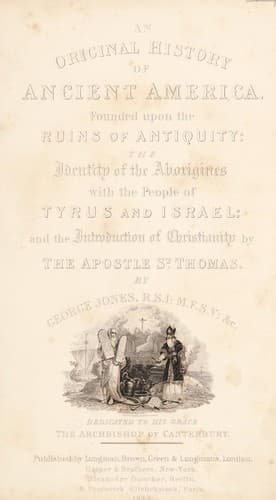
The History of Ancient America, Anterior to the Time of Columbus: Proving the Identity of the Aborigines with the Tyrians and Israelites; and the Introduction of Christianity into the Western Hemisphere By The Apostle St. ThomasJones, George
History
The History of Ancient America, Anterior to the Time of Columbus: Proving the Identity of the Aborigines with the Tyrians and Israelites; and the Introduction of Christianity into the Western Hemisphere By The Apostle St. Thomas
Jones, George
America -- Antiquities; America -- Discovery and exploration -- Phoenician; Indians -- Origin
The custom of Scalping cannot be said with truth to be original with
the Northern native: it has, however, been so asserted, as proof that
they are more modern as a people than this theory would establish; but
the declaration "melts into air, into thin air," from the fact, that
both Herodotus and Polybius mention scalping as being practised among
the most ancient nations of the world. The assertion, therefore, has
only brought forward its refutation. Scalping was introduced
originally by the ancients for the express purpose of counting and
recording the number of the foe slain in battle: and especially was
this custom practised by the Scythians: this is established upon the
authority of the accurate Herodotus. For the same reason is the custom
followed by the Aborigines of the North--viz., to number the slain of
the enemy. Again, Scythia was the ancient name of the country now
known by the modern name of Tartary. This is important, as will be
shewn in the next volume, in tracing the encampments of the
_Israelites_ after their escape from captivity; for in the Scythian
Tartary they will be found: and consequently the custom may have been
derived from their own remote ancestors, who obtained it from the
Scythians. The custom with both was (and in the North still _is_),
only for a trophy of the _dead_, and, therefore the scalp is never
taken from a _living_ enemy. Polybius, however, has a Draconian
record--viz., that upon the occasion of _Gisco_ the Carthaginian being
made prisoner, together with 700 of his soldiers, they were all
scalped _alive_ by the rebel mercenaries under Spondius. The ancients,
also, wore the long scalp-locks as the flowing hair to their rude
helmets and weapons: the natives of the North do the same as records
of their personal victories. This subject has been dwelt upon, in
order to prove its great antiquity.
Public-domain text, read in full here on John Shaqi.
Reviews
Reviews
No reviews yet
Be the first to share your thoughts on this work.
Join the Discussion
Join the discussion
Sign in to leave a comment or review.
Sign InorCreate an account