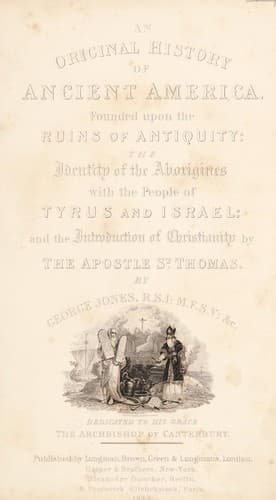
The History of Ancient America, Anterior to the Time of Columbus: Proving the Identity of the Aborigines with the Tyrians and Israelites; and the Introduction of Christianity into the Western Hemisphere By The Apostle St. ThomasJones, George
History
The History of Ancient America, Anterior to the Time of Columbus: Proving the Identity of the Aborigines with the Tyrians and Israelites; and the Introduction of Christianity into the Western Hemisphere By The Apostle St. Thomas
Jones, George
America -- Antiquities; America -- Discovery and exploration -- Phoenician; Indians -- Origin
The ships of the Expedition were built by the Tyrians;--piloted,
manned, and equipped by them, and consequently the voyage belongs to
their history conjointly with that of Egypt. Let us review the
circumstance which led to the Expedition, and the means of defraying
the expense:--the latter will be found to emanate from the coffers of
Judæa, and not from those of Egypt. Pharaoh-Necho possessed a mind of
no ordinary character, not only in regard to government, but for
scientific pursuits. Six years after his ascension to the throne he
declared war against the King of Babylon, and marched an army towards
the Euphrates. It was at this time that Josiah "the pious," King of
Judah, followed the Monarch of Egypt, for the purpose of making
warfare upon him and his army, and thus prevent his approach upon the
Babylonians. Pharaoh used every entreaty to Josiah to entice him to
return to his own nation, as he had no wish to make battle with Judæa,
but rather desired the amity of that country. Josiah, however, still
followed on the rear of the Egyptian army,--when Pharaoh suddenly
turned upon the Judæan force, before the approach of the army of
Babylon. The two enemies met in the plain of Megiddo. Josiah was
mortally wounded, carried from the field in his chariot, and shortly
after died at Jerusalem. His son Jehoahaz succeeded him, but reigned
only three months, when he was dethroned by the indignant Pharaoh, and
Josiah's eldest son crowned by orders of the Egyptian, and Judæa
placed under an annual tribute "of an hundred talents of silver, and a
talent of gold." [_i. e._ 41,425_l._] This event occurred 610 B. C.;
and returning victorious to Egypt, Pharaoh probably contemplated how
he might best employ the Judæan tribute, and make it available in the
paths of peace. From relative circumstances we are led to reason that
such were his thoughts,--for we now find that he resolved to attempt
the joining of the Red Sea with the Mediterranean, or with the River
Nile, by means of a Ship-Canal between either of the two waters. Egypt
would then receive merchandise direct from India, passing through the
Straits of Babelmandeb, and so through the Red Sea and the Gulf of
Suez; and by means of the proposed Canal to some harbour, or
commercial emporium to be erected on the banks of the Nile, at the
fork of the Delta, or at one of the mouths of the river on the
Mediterranean.
Public-domain text, read in full here on John Shaqi.
Reviews
Reviews
No reviews yet
Be the first to share your thoughts on this work.
Elsewhere in the archive
Join the Discussion
Join the discussion
Sign in to leave a comment or review.
Sign InorCreate an account