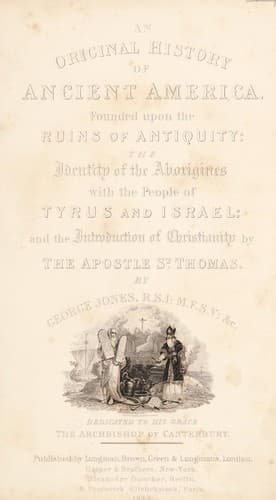
The History of Ancient America, Anterior to the Time of Columbus: Proving the Identity of the Aborigines with the Tyrians and Israelites; and the Introduction of Christianity into the Western Hemisphere By The Apostle St. ThomasJones, George
History
The History of Ancient America, Anterior to the Time of Columbus: Proving the Identity of the Aborigines with the Tyrians and Israelites; and the Introduction of Christianity into the Western Hemisphere By The Apostle St. Thomas
Jones, George
America -- Antiquities; America -- Discovery and exploration -- Phoenician; Indians -- Origin
This policy of a commercial connexion between the Nile and Suez, and
so to India, is again revived at the present day, after a lapse of
nearly 2500 years! At this time, 610 B. C., Egypt had no commerce of
her own, and had always despised the merchant's pursuit. She had no
navy or vessels of her own,--except her river boats,--yet she was
willing to receive from other nations the rich commodities derivable
from their commercial energy, and in _exchange_ for her corn and linen
cloths; consequently the Egyptians were _merchants_ at the very time
they affected to despise the means whereby merchandise was acquired.
To the fact of the Egyptians really despising and rejecting
Navigation, may be attributed the _land_ wonders of the Nile,--the
Pyramids and Temples:--for not being engaged upon the Ocean, or the
Mediterranean in any manner (and to leave the river Nile for other
waters was esteemed a sacrilege), they of a necessity could turn their
attention only to the grandeur of the Earth,--naturally or
artificially,--_i. e._ to Agriculture, or the Arts,--and they were
content to leave the domain of Neptune to those who were willing to
become the bold subjects of his treacherous empire!
In the attempt to form a Canal from the Red Sea the King of Egypt
completely failed, probably owing to the drifting sands; and it was
this defeat in one path of Science, that led him instantly to pursue
another, in which he would not have the same difficulties of Nature to
contend with; and in this resolve he was actuated by the safety of his
reputation,--for the new idea had precisely the same object in view,
as that in which he had so signally failed;--viz., to bring the riches
of India and the Nile together by means of water communication. The
only way whereby this could be accomplished was by a circumnavigation
of the Continent of Africa. There seems to be truth upon the entire
subject of this Voyage, from the fact, as already expressed, that the
second scientific attempt, had for its object the same as the first.
This is a proof that the Voyage was not attempted or accomplished in
the time of Solomon and Hiram;--for if it had been, it would no longer
have been a question, but a repetition of a "foregone conclusion."
The primitive undertaking of Pharaoh did not require Pilots or
mariners,--the expedition now to be attempted not only demanded both,
but also Galleys and "all the appliances and means" of Navigation,--these
the Egyptians, like the Israelites, did not possess, nor had they any
practical Knowledge of the Science.
There was but one Nation in the world to which Pharaoh could apply,
for carrying into effect this bold and original undertaking,--that
Nation was Tyrus:--and with the Monarch of that country the Sovereign
of Egypt was on terms of amity.
Public-domain text, read in full here on John Shaqi.
Reviews
Reviews
No reviews yet
Be the first to share your thoughts on this work.
Elsewhere in the archive
Join the Discussion
Join the discussion
Sign in to leave a comment or review.
Sign InorCreate an account