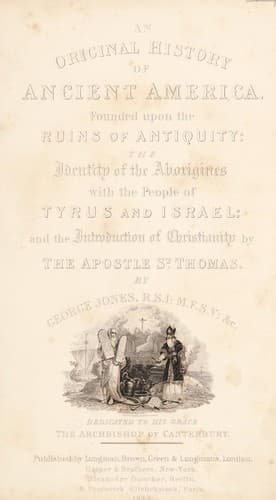
The History of Ancient America, Anterior to the Time of Columbus: Proving the Identity of the Aborigines with the Tyrians and Israelites; and the Introduction of Christianity into the Western Hemisphere By The Apostle St. ThomasJones, George
History
The History of Ancient America, Anterior to the Time of Columbus: Proving the Identity of the Aborigines with the Tyrians and Israelites; and the Introduction of Christianity into the Western Hemisphere By The Apostle St. Thomas
Jones, George
America -- Antiquities; America -- Discovery and exploration -- Phoenician; Indians -- Origin
"Though he be fruitful among his brethren, an _East-wind_ shall come,
the wind of the LORD shall come up from the _wilderness_, and his
spring shall become dry, and his fountain shall be dried up: he shall
spoil the treasure of all pleasant vessels."
"I will scatter them as with _an East-wind_ before the enemy: I will
shew the back and not the face, in the day of their calamity."
"Yea, behold, being planted shall it prosper? Shall it not utterly
wither when the _East-wind_ toucheth it? It shall wither in the
furrows where it grew."
"But she was plucked up in _fury_, she was cast down to the ground,
and the _East-wind_ dried up her fruit: her strong rods were broken
and withered, the fire consumed them."
Another quotation from EZEKIEL is reserved for the next Section, to
illustrate the Expedition.
In the Book of JONAH, the very _cause_ of the East-Wind (_i. e._
_heat_) is given by the Prophet of Nineveh,--not given as an
explanation, but as an attendant fact,--after 2700 years Science gives
the former, by an application of the fact, and thus establishes
another proof of the truth of Scriptural record.
"And it came to pass, when the _Sun did arise_, that GOD prepared _a
vehement East-wind_: and _the Sun_ beat upon the head of Jonah, that
he fainted, and wished in himself to die, and said, It is better for
me to die than to live." [iv. 8.]
Presuming that this branch of our subject has been sufficiently
explained,--a slight review of the Tyrian vessels will be required,
for the purpose of ascertaining whether they were of sufficient size
and strength to endure this voyage around the Continent of Africa; and
at a later period to cross the Atlantic Ocean. One examination will
answer for both questions.
The Tyrians had two species of large vessels. The earliest were the
_Gauli_, so called from being nearly round, and used for coasting
purposes, between Tyrus and the neighbouring ports,--this species of
Galley had a sail and a few oars. The superior vessels for long
voyages were Galleys of a much larger class, and oblong in
shape,--they had one, two, or three banks of oars, in addition to one
or two very large square-sails. The _rows_ of oarsmen (hence the name
of _rowers_ to this time, although the mode of working has passed
away) were so placed on their banks or seats, as to be all seen by the
officer of the deck,--for the centre of the Galley was open down
nearly to the ballast. They all kept time, and moved together, by
watching the action of the officer (at the stern of the vessel) having
the command of the rowers,--or by _singing_,--hence, we apprehend,
arose the marine name,--Mer-chants, _i. e._ Singers of the Sea,--for
the name is first applied in Scripture to the Tyrians.
Public-domain text, read in full here on John Shaqi.
Reviews
Reviews
No reviews yet
Be the first to share your thoughts on this work.
Elsewhere in the archive
Join the Discussion
Join the discussion
Sign in to leave a comment or review.
Sign InorCreate an account