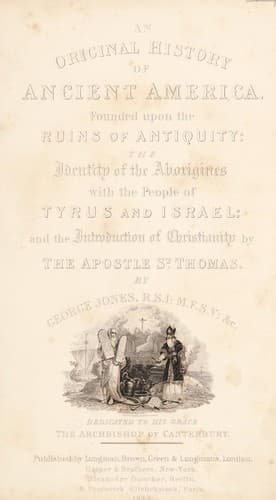
The History of Ancient America, Anterior to the Time of Columbus: Proving the Identity of the Aborigines with the Tyrians and Israelites; and the Introduction of Christianity into the Western Hemisphere By The Apostle St. ThomasJones, George
History
The History of Ancient America, Anterior to the Time of Columbus: Proving the Identity of the Aborigines with the Tyrians and Israelites; and the Introduction of Christianity into the Western Hemisphere By The Apostle St. Thomas
Jones, George
America -- Antiquities; America -- Discovery and exploration -- Phoenician; Indians -- Origin
It has already been shewn that a Tyrian navy was built for King
SOLOMON nearly four hundred years before this period, and that it
returned from India in safety. Of the size of those vessels there is
no record; but from the character of the Voyage, conclusions may be
formed, as also of those employed in the Expedition now under
consideration. From the following data a satisfactory deduction will
be obtained: viz.--The Galley in which ST. PAUL embarked at his
reshipment, and that, too, belonging to the Tyrian side of the
Mediterranean, contained two hundred and seventy-six human
beings,--consequently it was from 400 to 500 tons burden. "And we were
in all, in the ship, two hundred, three score, and sixteen souls."
[Acts xxvii. 37.]
The Tyrian Galleys, as we have shewn, had not only large sails, but
many Rowers,--so that calm weather was no hindrance to their progress.
The "hundred oars" took the place of Steam, as now employed upon the
Ocean, to be used in all weathers, and consequently independent of the
sail,--the latter being used as the wind would permit. The Sail was
generally employed only before the wind, or slightly on the
quarter,--otherwise the pressure of the wind upon the sail would heave
one side of the vessel down, and consequently drown the oars, while
the opposite rowers would be useless, from their oars being out of
water. The great force with which the ancient rowers could propel
their Galleys, may be gathered from the naval engagement of Salamis
(the "Nile" of the Greeks), where their prow-beaks were driven into
the sides of the Persian vessels,--and thus grappled, they boarded the
invaders, and fought hand to hand; while many of the Persian Galleys
were run down, and instantly sunk by the force and impetuosity of the
Rowers, who, be it remembered, were like the Tyrians, not "_slaves_ at
the oar," but the _freemen_ of their respective nations.
The vessels were also capacitated to carry sufficient provisions for
long voyages; and in this Expedition, which was to circumnavigate the
Continent of Africa, the Tyrians would consequently keep in sight of
land,--for by _coasting_ only, could their peculiar object be
accomplished; and therefore the food to be obtained by fishing (their
favourite pursuit) near the shores would alone have been ample. Fresh
water, also, from the coasting character of the voyage, would be
always within their reach.
Public-domain text, read in full here on John Shaqi.
Reviews
Reviews
No reviews yet
Be the first to share your thoughts on this work.
Elsewhere in the archive
Join the Discussion
Join the discussion
Sign in to leave a comment or review.
Sign InorCreate an account