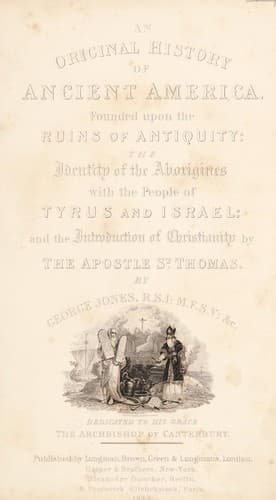
The History of Ancient America, Anterior to the Time of Columbus: Proving the Identity of the Aborigines with the Tyrians and Israelites; and the Introduction of Christianity into the Western Hemisphere By The Apostle St. ThomasJones, George
History
The History of Ancient America, Anterior to the Time of Columbus: Proving the Identity of the Aborigines with the Tyrians and Israelites; and the Introduction of Christianity into the Western Hemisphere By The Apostle St. Thomas
Jones, George
America -- Antiquities; America -- Discovery and exploration -- Phoenician; Indians -- Origin
They now coasted along the shores of Morocco and Fez, and entering the
Straits of Gibraltar, passed the Pillars of Hercules, and floated on
the waters of their native Sea,--thus proving for the first time that
the boundary Columns of Alcides had been erected in vain;--and also,
that human ingenuity and perseverance will conquer, and bear down all
the barriers erected by Superstition as the landmarks of human
Intellect!
In their triumphant passage along the shores of the Mediterranean,
Carthage would not be passed unvisited by the descendants of the same
race, who had followed the fortunes of a Tyrian Princess, when driven
from her own land by treachery and cruelty. Leaving the Republic of
Carthage, (in which commercial storehouse they must have seen the
germs of a future rival,) with what pride and joy must they have
reached the Delta of the Nile?--and beyond those feelings, when Tyrus
was seen from the round-top of a galley-mast,--or when from their
native shore they received the united voice of a gladdened nation?
Three years of danger and unyielding courage, upon an extended field
of Science, preserved the fame of Egypt's King, and gave new and
brilliant glory to the Tyrians and their Sovereign.
Pharaoh-Necho had achieved his wish by the circumnavigation of the
Continent, of which Egypt was the Capital, and this being the only
object of the Egyptian, all discoveries of Islands, as forming no part
of the African Continent, would therefore be claimed by the Tyrians
as their own. The Fortunate Isles (_i. e._ Canaries) for
instance,--and consequently Ithobalus and his successors, would be the
rightful "Kings of those Islands" discovered during this voyage, and
situated "beyond the Sea,"--and to be reached by passing through the
Gates of Gades,--_i. e._ Straits of Gibraltar.
Even if Pharaoh had claimed the Isles discovered, it would have been
useless, for he had no navy (if opposed by Tyrus) to support that
claim. It is not probable that he would attempt it,--but even the
supposition is set at rest, for the King of Babylon conquered
Pharaoh-Necho and Egypt, only _seven years_ after this voyage, for
compelling him to raise the first Siege of Jerusalem. Pharaoh was
receiving his annual tribute from the Jews: Nebuchadnezzar, therefore,
instantly left Judæa and turned his warfare upon the Egyptians,
[599 B. C.] captured all the treasure of the Nile, and returned
triumphant to the Euphrates.
Public-domain text, read in full here on John Shaqi.
Reviews
Reviews
No reviews yet
Be the first to share your thoughts on this work.
Elsewhere in the archive
Join the Discussion
Join the discussion
Sign in to leave a comment or review.
Sign InorCreate an account