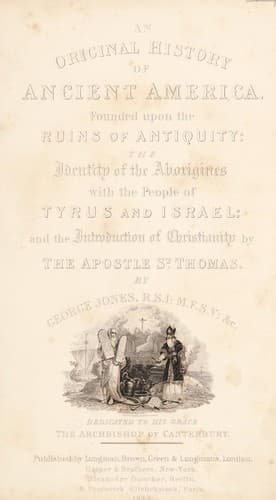
The History of Ancient America, Anterior to the Time of Columbus: Proving the Identity of the Aborigines with the Tyrians and Israelites; and the Introduction of Christianity into the Western Hemisphere By The Apostle St. ThomasJones, George
History
The History of Ancient America, Anterior to the Time of Columbus: Proving the Identity of the Aborigines with the Tyrians and Israelites; and the Introduction of Christianity into the Western Hemisphere By The Apostle St. Thomas
Jones, George
America -- Antiquities; America -- Discovery and exploration -- Phoenician; Indians -- Origin
This Section will be concluded by producing the authority of Scripture
(with the incident of Nature) to support the statement of Herodotus:
and although the Prophets will be quoted, in this instance Prophecy
itself has no bearing upon the subject,--their words upon this direct
investigation only refer to that _which had taken place_, and
consequently only of past record, and not for predictions of a future.
This was the case with JEREMIAH and EZEKIEL, but,--_not with_
ISAIAH,--and upon this fact do we rest the Scriptural record of the
successful accomplishment of this Voyage. Our argument is as
follows,--viz., In the Prophecy by ISAIAH already quoted [Book ii.,
ch. v.] there is no allusion whatever to this Expedition, and for the
reason,--that ISAIAH wrote of the doom of Tyrus 106 years _before_ the
period of this Voyage,--consequently the absence of all notice by this
Sacred writer (the subject not being prophetical) proves at least that
the naval enterprise was undertaken _after_ the time in which he
prophecied the downfall of the Tyrian Nation:--Following out this
train of reasoning, any Prophet, therefore, who came _after_ the
Expedition, and in speaking, or writing, of Tyrus, _should allude to
it_ as having taken place,--for it would form another item in the
gathered glory of Sidon's Daughter, and would be included in that long
list of pride about to be cancelled by the Babylonian Conquest. The
reader will find that the later Prophets _did_ allude to this Voyage,
and, also, to the cluster of Isles of which Teneriffe is the
principal.
The first of these is JEREMIAH, who prophesied the destruction of
several offending Nations, in the first year of the reign of the King
of Babylon, and the fourth of Jehoiakim, Monarch of Judæa,--this was
in the beginning of the year 606 B. C. Now supposing that the Voyagers
left Suez in the commencement of the year 609 B. C. and occupying
three years in the enterprise,--would bring the defined period to the
end of 607 B. C.--consequently JEREMIAH wrote his words _only a few
Months_ after the triumphant issue, and discovery of "the Isles beyond
the Sea,"--the account of which would speed through Judæa and the
surrounding nations, as it had through Egypt and Tyrus. It is a
remarkable circumstance, that in tracing back the history of this
Voyage nearly 2500 years, that it should be found to have been alluded
to only a few months,--perhaps weeks--after its accomplishment, and in
the sacred page of Scripture: and it is still more singular, that
writers upon this subject of record by Herodotus, should have passed
it unheeded; as, also, the allusion by EZEKIEL.
The Prophecy by JEREMIAH concerning Judæa, as well as of Tyrus, will
be quoted in order to shew the character of the approaching
destruction. The last lines contain the allusion mentioned, having
reference to the discovery of the Fortunate Isles.
Public-domain text, read in full here on John Shaqi.
Reviews
Reviews
No reviews yet
Be the first to share your thoughts on this work.
Elsewhere in the archive
Join the Discussion
Join the discussion
Sign in to leave a comment or review.
Sign InorCreate an account